A Fractional Chief Data Officer from MinervaDB gives an enterprise board-level data leadership — strategy, architecture, governance and operations — on a part-time, fixed-fee basis. When that mandate is pointed squarely at real-time analytics, the role stops being an organisational nicety and becomes a profit-and-loss instrument: it determines how quickly your business can see an event, decide on it, and act before the opportunity decays.
This article is deliberately written to be read by five different people at the same table. The CEO will find the commercial thesis. The CTO will find the reference architecture, the latency budget and the engineering standards. The CFO will find unit economics, total cost of ownership and payback. The board and investors will find the governance, risk and diligence position. All five are looking at the same estate; a Fractional Chief Data Officer exists to make sure they are looking at the same numbers.
What this article covers
- Why real-time analytics became a board-level question
- What a Fractional Chief Data Officer owns in a real-time estate
- The latency budget: milliseconds as a managed asset
- Decision decay: the economic case for real-time
- Seven proven wins
- The technical blueprint for the CTO
- Unit economics for the CFO
- Governance, risk and diligence for the board and investors
- The first 90 days
- The executive scorecard
- Engagement models and commercials
- Fractional versus full-time versus advisory
- Frequently asked questions
Why Real-Time Analytics Became a Board-Level Question
For most of the last decade, analytics was a reporting function. Data landed overnight, a warehouse transformed it, and the business read yesterday. That model is no longer competitive in any market where price, inventory, credit, fraud, capacity or customer intent move within the trading day. The shift is not technological fashion. It is a change in where margin is created.
Real-time analytics changes three things a board cares about. It shortens the interval between an event and a decision, which is where most recoverable value sits. It exposes operational truth continuously rather than in a monthly pack, which changes the quality of governance. And it converts analytics from a fixed reporting cost into a variable, attributable one — which is precisely why it needs an owner with executive authority, not a project team.
That owner is the problem. Streaming estates fail commercially far more often than they fail technically. Pipelines get built, dashboards refresh in seconds, and the organisation still argues about which revenue number is correct, still cannot attribute the cloud bill, and still cannot show an auditor where personal data flows. A Fractional Chief Data Officer is the corrective: one accountable executive who holds strategy, architecture, cost and compliance together across the entire real-time path.
What a Fractional Chief Data Officer Owns in a Real-Time Analytics Estate
Real-time analytics is a chain, and a chain is owned end to end or not at all. The diagram below is the path an event travels from the moment it is committed in a system of record to the moment a human or a model acts on it. Every hop in that path has a latency cost, a failure mode, a cost line and a compliance implication. The Fractional Chief Data Officer owns all four dimensions across every hop.
Figure 1 — The real-time analytics path a Fractional Chief Data Officer governs end to end, with the latency budget allocated hop by hop.
Each stage is a genuine engineering discipline. Capture is usually log-based change data capture reading the write-ahead log, following the mechanics described in the PostgreSQL logical replication documentation and implemented with Debezium. Transport is an ordered, replayable log, normally Apache Kafka. Processing is stateful stream computation with checkpointing, typically Apache Flink. Serving is a column store tuned for high-cardinality, low-latency aggregation, such as ClickHouse and its MergeTree family of table engines.
What no vendor supplies is the arbitration between them. Which events are worth streaming at all? Which consumers are entitled to which fields? What is an acceptable staleness for a pricing decision versus a regulatory report? Who pays when a single badly written dashboard query scans forty terabytes? These are executive questions with engineering answers, and they are the daily work of a Fractional Chief Data Officer. MinervaDB backs that judgement with delivery capability through ClickHouse consulting, PostgreSQL consulting and our high-performance data engineering practice.
The Latency Budget: How a Fractional Chief Data Officer Turns Milliseconds Into Margin
Real-time is not a marketing adjective; it is a number with an owner. The single most useful artefact a Fractional Chief Data Officer introduces in the first month is a written latency budget: an explicit allocation of the end-to-end service level objective across every hop, with a named owner and an alert for each allocation. Once the budget exists, arguments about whether the platform is fast enough stop being subjective.
Figure 2 — A published latency budget: every hop has an allocation, an owner and an alert. Unallocated headroom is a deliberate reserve, not luck.
Two disciplines make the budget real. The first is error-budget thinking, borrowed from site reliability engineering and set out in the Google SRE book chapter on service level objectives: an objective without a consequence is a wish. The second is physical design. In a column store, latency and cost are both functions of sort order, partitioning, codecs and pre-aggregation — which is why a Fractional Chief Data Officer signs off storage layout the way a chief financial officer signs off capital expenditure.
ClickHouse · real-time ingest with a governed physical design-- Ordered, replayable ingest. Consumer group, format and parallelism are
-- reviewed artefacts, not defaults inherited from a tutorial.
CREATE TABLE rt.order_event_queue
(
    event_time       DateTime64(3),
    tenant_id        UInt32,
    order_id         String,
    country          LowCardinality(String),
    channel          LowCardinality(String),
    net_amount       Decimal(18, 2),
    is_fraud_flagged UInt8
)
ENGINE = Kafka
SETTINGS kafka_broker_list   = 'kafka-01:9092,kafka-02:9092',
         kafka_topic_list    = 'commerce.orders.v2',
         kafka_group_name    = 'ch_rt_orders',
         kafka_format        = 'JSONEachRow',
         kafka_num_consumers = 4;

-- Serving table. Sort order comes from measured query patterns; retention and
-- tiering are signed off by the Fractional Chief Data Officer as cost policy.
CREATE TABLE rt.order_event
(
    event_date       Date DEFAULT toDate(event_time),
    event_time       DateTime64(3),
    tenant_id        UInt32,
    order_id         String,
    country          LowCardinality(String),
    channel          LowCardinality(String),
    net_amount       Decimal(18, 2),
    is_fraud_flagged UInt8
)
ENGINE = MergeTree
PARTITION BY toYYYYMM(event_date)
ORDER BY (tenant_id, country, event_time)
TTL event_date + INTERVAL 6  MONTH TO VOLUME 'cold',
    event_date + INTERVAL 25 MONTH DELETE
SETTINGS index_granularity = 8192;

-- Pre-aggregate the handful of questions the business asks every minute,
-- so that a dashboard refresh never becomes a full-table scan.
CREATE MATERIALIZED VIEW rt.order_minute_mv TO rt.order_minute AS
SELECT toStartOfMinute(event_time)  AS minute,
       tenant_id,
       country,
       countState()                 AS orders_state,
       sumState(net_amount)         AS revenue_state,
       sumState(is_fraud_flagged)   AS flagged_state
FROM rt.order_event
GROUP BY minute, tenant_id, country;
Decision Decay: The Economic Case a Fractional Chief Data Officer Puts to the CFO
The commercial argument for real-time analytics is not that faster is nicer. It is that the value of a decision decays, often steeply, from the moment the triggering event occurs. A fraud signal acted on in 400 milliseconds prevents a loss; the same signal in the overnight batch documents one. An abandoned basket recovered within the session converts; recovered tomorrow it annoys. A Fractional Chief Data Officer makes that decay curve explicit, attaches revenue to it, and uses it to size investment.
Figure 3 — Decision decay. A Fractional Chief Data Officer prices the area under this curve, then designs the latency budget in Figure 2 to recover it.
Seven Proven Wins a Fractional Chief Data Officer Delivers in Real-Time Analytics
These are the outcomes we contract to. They are stated as measurable changes rather than activities, because a Fractional Chief Data Officer engagement is only credible if the board can verify it.
1. One certified real-time metric layer
A small set of certified metrics — revenue, active customers, conversion, exposure — with a named owner, a written definition and a freshness service level. Finance, product and operations stop reconciling and start deciding.
2. A latency SLO somebody actually owns
An end-to-end objective decomposed hop by hop, instrumented, alerted and reported monthly. Performance stops being anecdotal and becomes a tracked commitment with an error budget.
3. Analytical cost per terabyte cut, not capped
Sort keys, codecs, pre-aggregation, tiering and retention are redesigned against real workloads. Typical outcome is a 40 to 60 per cent reduction in cost per terabyte scanned with equal or better latency.
4. Pipelines that survive replay and schema change
Exactly-once semantics, idempotent sinks, versioned schemas and a tested backfill path. Incidents become bounded operational events instead of week-long reconciliation projects.
5. Real-time risk and fraud controls you can evidence
Streaming rules and models applied within the decision window, with a full audit trail of what was known when. This is the control regulators and insurers ask to see.
6. AI and ML served from the same governed stream
Features computed once, registered, reused for training and inference, with drift monitoring. Models stop being pilots because the data path underneath them is already production-grade.
7. Diligence-ready governance
A data inventory, classification, lineage, retention and access model that survives an audit, an initial public offering readiness review or a buyer’s technical diligence without a fire drill.
The Technical Blueprint: What the CTO Gets From a Fractional Chief Data Officer
Engineering teams do not need another strategy deck. They need decisions made, written down and defended. A Fractional Chief Data Officer supplies exactly that: a short set of non-negotiable standards for the streaming estate, each of which removes a recurring class of incident. The three that matter most are the data contract, exactly-once delivery semantics, and measured rather than asserted service levels.
Data contracts for streams, reviewed like an API
Every significant topic publishes a contract: owner, classification, freshness commitment, schema, quality rules and breaking-change policy. Producers cannot silently drop a field. Consumers can depend on a stated service level. Auditors have one artefact to inspect. Quality assertions run in continuous integration in the manner described by the dbt data testing documentation, and a failing contract blocks promotion.
Data contract · versioned in source control, enforced in the pipeline# data-contracts/commerce.orders.v2.yaml
apiVersion: minervadb.com/v1
kind: StreamContract
metadata:
  name: commerce.orders
  version: 2.1.0
  owner: commerce-platform
  steward: fractional-cdo-office
spec:
  classification: restricted
  transport: kafka
  partitions: 24
  keyField: order_id
  ordering: per-key
  deliverySemantics: exactly-once
  freshnessSlo: PT2S          # event time to queryable in ClickHouse
  availabilitySlo: 99.95
  retention: P7D              # log retention; serving store keeps 25 months
  schema:
    - name: order_id
      type: string
      required: true
    - name: customer_email
      type: string
      required: true
      pii: true
      masking: sha256
    - name: net_amount
      type: decimal(18,2)
      required: true
      constraints: [">= 0"]
  quality:
    - rule: uniqueness(order_id)
      threshold: 1.0
      severity: blocker
    - rule: lag_p99_seconds(event_time, ingested_at)
      threshold: 2
      severity: critical
  breakingChangePolicy: majorVersionOnly
Service levels measured, not asserted
The monthly executive report is generated by a query, not written by a person. That single habit removes the most common failure of data leadership, which is a scorecard that quietly reflects opinion. The query below is the shape we deploy on day one of a Fractional Chief Data Officer engagement, and it is the same number the board sees.
ClickHouse · the freshness, quality and cost numbers behind the board pack-- End-to-end freshness and cost, produced by instrumentation rather than opinion.
SELECT
    dataset,
    quantile(0.50)(dateDiff('millisecond', event_time, ingested_at)) AS p50_lag_ms,
    quantile(0.99)(dateDiff('millisecond', event_time, ingested_at)) AS p99_lag_ms,
    countIf(dateDiff('millisecond', event_time, ingested_at) > slo_ms) * 100.0
        / count()                                                    AS slo_breach_pct,
    round(sum(read_bytes) / pow(1024, 4), 3)                         AS tb_scanned,
    round(sum(read_bytes) / pow(1024, 4) * 5.00, 2)                  AS est_cost_usd
FROM rt.pipeline_observability
WHERE ingested_at >= now() - INTERVAL 30 DAY
GROUP BY dataset
HAVING slo_breach_pct > 0.1 OR p99_lag_ms > 2000
ORDER BY slo_breach_pct DESC;
Where this work extends beyond governance into sustained operations, the Fractional Chief Data Officer draws on 24×7 remote DBA support, data analytics and warehousing support and, for retrieval and recommendation workloads, our vector data engineering capability.
Unit Economics: How a Fractional Chief Data Officer Reads the Real-Time Analytics Bill
Real-time platforms are billed by consumption, which means physical design decisions land directly on the invoice. A CFO does not need to understand sort keys; a CFO needs the cost expressed per unit of business activity and trended. A Fractional Chief Data Officer builds that bridge, replacing a single opaque cloud line item with attributable unit costs that a finance function can actually manage.
Figure 4 — Unit economics before and after a Fractional Chief Data Officer takes ownership of the real-time estate.
The mechanism is unglamorous and repeatable. Queries are profiled and the top decile by bytes scanned is redesigned or pre-aggregated. Retention is enforced instead of aspirational. Cold partitions move to cheaper storage on a schedule. Idle clusters are decommissioned rather than tolerated. Chargeback labels are applied so that every terabyte has an owner. MinervaDB runs this discipline continuously through our cloud database optimisation and FinOps practice, and it is what makes the investment case defensible rather than aspirational.
| Cost or risk line | Without executive data ownership | With a MinervaDB Fractional Chief Data Officer |
|---|---|---|
| Leadership cost | Full-time CDO salary, bonus, equity and search fee | Fixed monthly fee for 2–8 principal days, thirty-day exit |
| Analytical compute | Grows with usage; no owner of query efficiency | Cost per terabyte scanned tracked and reduced quarter on quarter |
| Storage | Everything retained forever “just in case” | Tiering and retention enforced by declared policy |
| Engineering opportunity cost | Senior engineers absorbed by reconciliation and incidents | Incident load falls; capacity returns to product work |
| Decision quality | Contested numbers, decisions taken on stale data | Certified metrics with published freshness objectives |
| Regulatory and audit exposure | Unquantified; discovered during an audit | Inventoried, classified, evidenced and reported monthly |
| Diligence and valuation risk | Data findings become price adjustments | Governance pack maintained continuously, not assembled in panic |
Governance, Risk and Diligence: The Board and Investor View
For a board, real-time analytics raises the stakes on governance rather than lowering them. Data moves faster, reaches more consumers and is embedded in automated decisions, which means an error propagates before anyone notices. Directors are entitled to ask a small number of hard questions, and a Fractional Chief Data Officer exists to answer them with evidence: where does personal data flow, who can read it, how long is it kept, what breaks if a pipeline fails, and what did we know at the moment a decision was automated?
Our governance model follows established practice rather than invention. Data management domains map to the DAMA Data Management Body of Knowledge, and privacy obligations map to the processing principles in Article 5 of the GDPR and their regional equivalents. The value MinervaDB adds is not the framework; it is the engineering rigour with which the framework is made executable in a streaming estate.
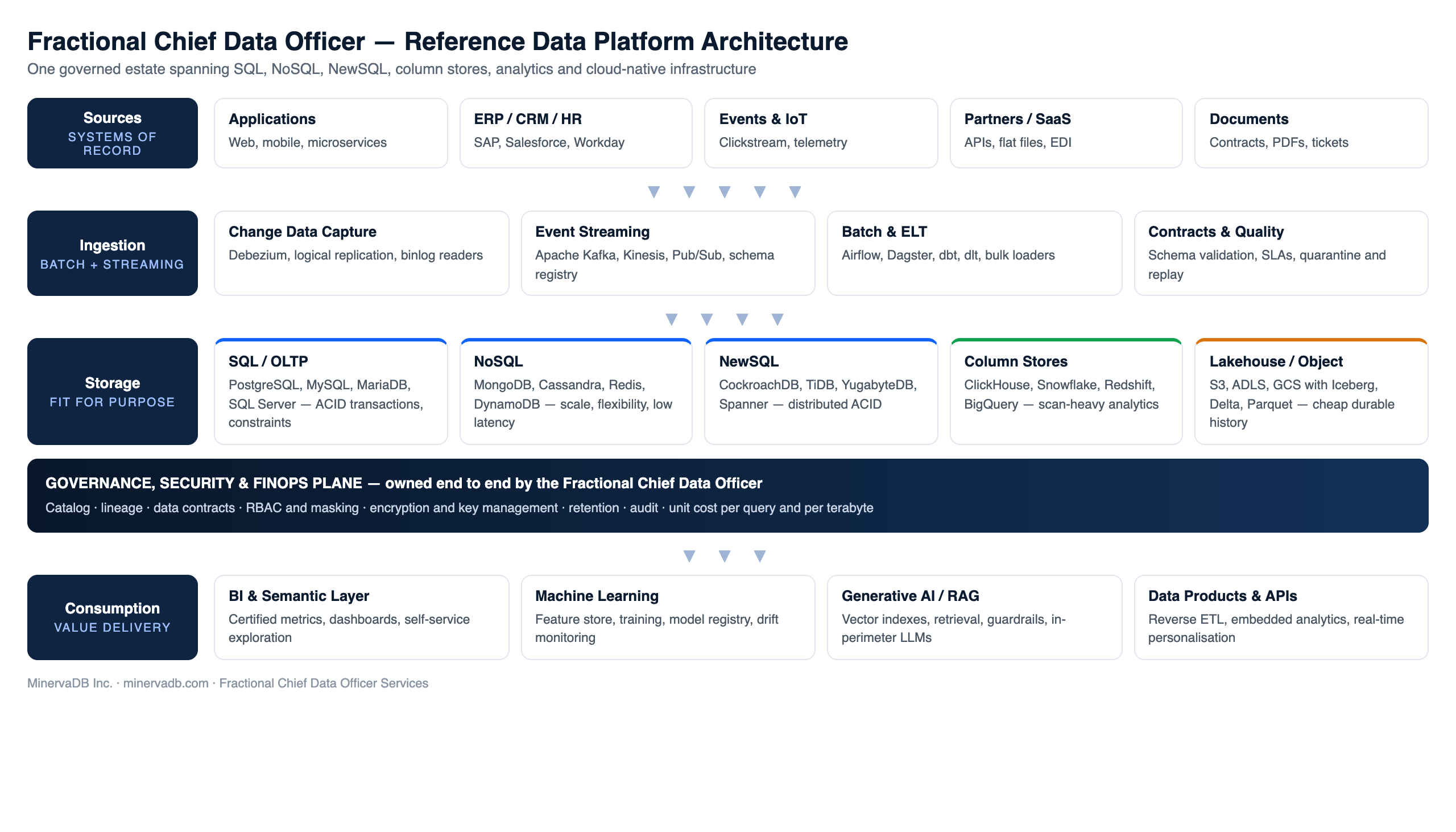
Figure 5 — The reference architecture a Fractional Chief Data Officer governs: fit-for-purpose storage under a single governance, security and FinOps plane.
Investors read this differently again. In diligence, data findings rarely kill a deal but frequently move the price. An estate with certified metrics, documented lineage, enforced retention and a measured cost base presents as a managed asset. The same estate without those artefacts presents as a liability with an unknown remediation cost, and it is discounted accordingly. Engaging a Fractional Chief Data Officer eighteen months before a raise or an exit is, in our experience, one of the cheapest forms of valuation protection available. Our perspective on database transformation for CIOs and our global capability centre data leadership programme describe how that capability is sustained at scale.
The First 90 Days With a MinervaDB Fractional Chief Data Officer
Every engagement follows the same evidence-led sequence: assess before advising, architect before building, and prove value on two or three real-time use cases before asking for a larger budget.
Figure 6 — The MinervaDB Fractional Chief Data Officer engagement roadmap, from assessment to a recurring executive scorecard.
The Executive Scorecard a Fractional Chief Data Officer Reports Against
The scorecard is agreed in the first month and reported every month thereafter, generated from instrumentation. Four numbers carry most of the signal for a real-time estate: are we fresh, are we correct, what does it cost, and how fast can we act?
Figure 7 — Indicative twelve-month scorecard. Every figure is produced by a query the client can run independently.
Fractional Chief Data Officer Engagement Models
We offer three engagement shapes. All are fixed monthly fees with a named principal, a defined day commitment and a thirty-day exit. None involves a leverage pyramid or a junior delivery team.
Advisory — 2 days per month
Governance council chairing, architecture review and approval, quarterly board reporting and an escalation line for critical real-time decisions. Suited to organisations with a capable engineering team that lacks executive data leadership.
Embedded — 4 to 6 days per month
Everything in Advisory, plus hands-on ownership of the streaming roadmap, vendor selection, data contracts, latency SLOs, the cost programme and the hiring plan. The most common shape.
Transformation — 8+ days per month
A MinervaDB delivery pod behind the Fractional Chief Data Officer. Used for migrations, consolidations, regulatory remediation and post-acquisition integration where execution capacity is required alongside leadership.
Fixed-scope assessments of two to four weeks are also available, and many clients start there. Where a MinervaDB relationship already exists, the Fractional Chief Data Officer can be layered on top of MinervaDB consultative support without renegotiating the underlying operational contract.
Fractional Chief Data Officer Versus a Full-Time Hire or an Advisory Firm
| Consideration | Full-time CDO hire | Strategy advisory firm | Contract architect | MinervaDB Fractional Chief Data Officer |
|---|---|---|---|---|
| Time to productive contribution | Six to nine months including search | Four to eight weeks of discovery | Two to four weeks | Under two weeks |
| Annual cost of leadership | Salary, bonus and equity | Large fixed programme fee | Daily rate, no mandate | Fixed monthly fee, scalable |
| Hands-on real-time engineering depth | Variable | Generally weak | Strong but narrow | Principal-level across the estate |
| Executive authority | Full | Advisory only | None | Full, by written mandate |
| Accountability for outcomes | Yes | Recommendations only | Task level | Yes, against an agreed scorecard |
| Delivery capacity behind the role | Requires separate hiring | Costly and generalist | None | MinervaDB engineering pods on demand |
| Exit risk if it is not working | High and slow | Contractual | Low | Thirty days |
The honest position is this. At sufficient scale, a permanent Chief Data Officer is the right answer. A Fractional Chief Data Officer is the right answer before you reach that scale, while you are recovering from a stalled real-time programme, or while you are preparing the organisation so that a permanent hire succeeds rather than becomes your second attempt.
Frequently Asked Questions About Fractional Chief Data Officer Services
What is a Fractional Chief Data Officer?
A Fractional Chief Data Officer is a senior data executive engaged part-time on a fixed fee who carries the full mandate of a Chief Data Officer — strategy, architecture, governance, quality, security, cost and value realisation — without the salary, equity and hiring risk of a permanent appointment.
How does a Fractional Chief Data Officer improve real-time analytics specifically?
By owning the whole path rather than a stage of it. That means a published latency budget, data contracts on every significant stream, exactly-once delivery semantics, a serving layer designed for the queries the business actually runs, and a cost model expressed per unit of business activity. Speed becomes a managed commitment instead of a demo.
How much time does the role commit each month?
Typically two to eight days per month. Advisory engagements start at two days, embedded engagements run at four to six, and transformation programmes require eight or more with a MinervaDB delivery pod behind the role.
Which technologies does the mandate cover?
The whole estate: relational systems such as PostgreSQL, MySQL, MariaDB and SQL Server; NoSQL platforms including MongoDB, Cassandra, Redis and DynamoDB; NewSQL engines such as CockroachDB, TiDB and YugabyteDB; streaming infrastructure including Kafka and Flink; column stores including ClickHouse, Druid, Snowflake, BigQuery and Redshift; and cloud native data platforms on AWS, Azure and Google Cloud.
How quickly will we see measurable results?
A prioritised risk register plus a measured latency and cost baseline within thirty days. An approved strategy and investment plan by day sixty. Working real-time data products and a board-readable scorecard by day ninety.
Will a Fractional Chief Data Officer replace our existing data team?
No. The role gives an existing team direction, standards, decision rights and executive cover. In most engagements the team becomes measurably more effective, and one of the deliverables is a hiring and capability plan for strengthening it further.
Can the engagement transition to a permanent Chief Data Officer?
Yes, and we plan for it from the outset. Every artefact — strategy, standards, contracts, runbooks and the scorecard — is written for handover. Many clients use a Fractional Chief Data Officer precisely to prepare the organisation so that a permanent hire succeeds.
How is data confidentiality handled?
Under a mutual non-disclosure agreement, with least-privilege access granted for the duration of the engagement only, and a preference for working inside your perimeter. Where regulation requires it, we work exclusively within your virtual private cloud with no data egress.
Put an accountable data executive in place this quarter
If real-time analytics is on your roadmap, on your risk register or in your investment case, the constraint is rarely technology. It is ownership. A MinervaDB Fractional Chief Data Officer supplies that ownership in weeks, at a fixed fee, with a thirty-day exit.
The first conversation is with the principal who would hold the mandate — an engineer who has run production data infrastructure at scale, never a salesperson. Book a conversation with a MinervaDB principal, or read more on our Fractional Chief Data Officer services page.
Running ClickHouse in production? MinervaDB provides ClickHouse consulting and 24×7 support as part of its database consulting services.
Running this in production?
MinervaDB provides ClickHouse Consulting, Data Analytics and Data Warehousing Support, Data Analytics Platform Engineering and Data Engineering Consulting with 24x7 coverage and a 15-minute S1 response. Talk to an engineer.