The Data Transformation Company

Data Architecture, Engineering and Operations for SQL, NoSQL, NewSQL, Cloud Native Data Platforms, Analytics and AI

  • MinervaDB
    • GCC Data Leadership
    • For CTOs
    • For CIOs
    • Full-Stack Optimization
    • Essential Remote DBA
    • MinervaDB University
  • Engineering
    • Fractional CDO
    • Data Science & AI
    • Cloud FinOps
      • MinervaDB Privacy Policy
    • Data Modernization
    • Databricks
    • Snowflake
    • Microsoft Azure
    • AWS
    • Google Cloud
    • AI and Vector Data
    • MySQL
    • PostgreSQL
    • PostgreSQL on Kubernetes
    • SQL Server Consulting
    • MariaDB Consulting
    • MongoDB Consulting
    • Ticketing System
  • Support
    • Enterprise Support
    • 24/7 Emergency DBA
    • PostgreSQL Support
    • MySQL Support
    • MariaDB Support
    • SQL Server Support
    • MongoDB Support
    • NoSQL
    • Kafka Support
    • Cloud Native
    • Analytics & DWH
  • Remote DBA
    • 24*7 Emergency DBA
    • 24/7 Remote DBA Works
    • Performance Optimization
    • PostgreSQL DBA
    • 24/7 MySQL DBA
    • 24/7 MariaDB DBA
    • NoSQL Services
    • MongoDB Services
  • Blog
    • MinervaDB Blog
  • Careers
  • Contact
    • MinervaDB Contacts
    • Book an Appointment
    • MinervaDB FAQ
    • Cookie Policy
    • MinervaDB Privacy Policy
  • Facebook
    • Data Ops. Geek
  • Twitter
    • @MinervaDB
    • @ShivIyer
    • @ChistaDATA
  • LinkedIn
    • Shiv Iyer
  • GitHub
    • @ShivIyer
HomeMinervaDB

MinervaDB

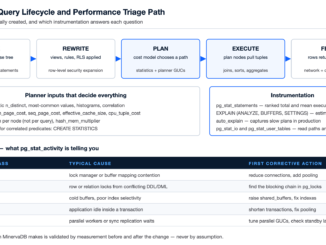
PostgreSQL Support diagram of the query lifecycle from parse to execute with planner inputs, pg_stat_statements instrumentation and a wait event triage table
MinervaDB

Optimizing SQLs in PostgreSQL 18.4: 12 Proven Techniques for Peak Performance

A practical field manual for optimizing SQLs in PostgreSQL 18.4: EXPLAIN with buffers, B-tree skip scans, asynchronous I/O, statistics, join tuning, six animated diagrams and seven premium diagnostic scripts.
[...]
Database Infrastructure

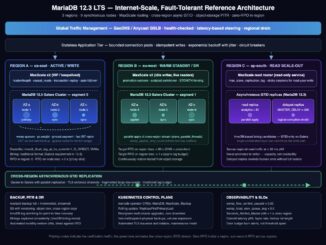
MariaDB 12.3 LTS: Advances and Building Fault-Tolerant MariaDB Infrastructure at Internet Scale

MariaDB 12.3 is the current long-term support release of MariaDB Community Server. It reached Stable/GA on 28 May 2026 and is maintained until June 2029, making it the first LTS line since MariaDB 11.8. For [...]
Milvus Observability
Milvus

Milvus Observability and Monitoring Infrastructure: Performance, Scalability, and High Availability

Most engineering teams discover the limits of their Milvus observability at two in the morning, somewhere between a p99 that has quietly tripled and a Grafana dashboard that only knows how to show CPU. Milvus [...]
Essential MariaDB Performance Metrics
MariaDB

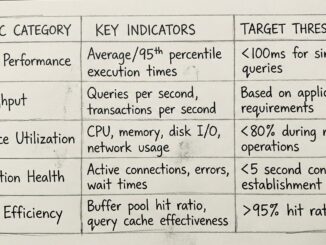
MariaDB Performance Monitoring: 20 Essential Metrics Every DBA Should Track for Troubleshooting

Why MariaDB Performance Monitoring Fails Without Baselines MariaDB performance monitoring is what separates a diagnosis from a guess. Most MariaDB incidents are never actually diagnosed. When a production cluster degrades at 02:00, the on-call DBA [...]
Redis Performance Troubleshooting
Data Strategy

Redis Performance Troubleshooting: A Field Guide to Diagnosing and Resolving Production Bottlenecks

Redis Performance Troubleshooting is the single most valuable skill for any team running Redis at scale. When a production Redis instance slows down, the symptoms are rarely obvious: latency spikes appear intermittently, memory climbs without [...]
PostgreSQL 18 Performance
MinervaDB

PostgreSQL 18 Performance Configuration Matrix: New Parameters and MinervaDB Tuning Recommendations

The release of PostgreSQL 18 introduces one of the most consequential rounds of configuration changes the project has shipped in years. For database engineers and site reliability teams, understanding PostgreSQL 18 performance tuning is no [...]
Partitioned Table Statistics
MinervaDB

Partitioned Table Statistics in PostgreSQL: How ANALYZE Fixed a Slow Query

Partitioned table statistics are one of the most misunderstood corners of PostgreSQL performance tuning, and getting partitioned table statistics right is often the fastest win available to a DBA. A partitioned table can look perfectly [...]
UPDATE LIMIT in PostgreSQL
Datatbase Systems

How to Do UPDATE … LIMIT in PostgreSQL (With Standard SQL Alternatives)

If you have ever migrated a workload from MySQL to PostgreSQL, you have probably hit a wall the first time you tried to run a statement like UPDATE mytable SET status = 'done' LIMIT 100;. [...]
Milvus Vector Database
AI

Milvus Vector Database: 7 Powerful Scalable Search Tips

Milvus vector database has quickly become one of the most widely adopted open-source engines for powering similarity search at scale. As AI applications move from experimental notebooks into production systems that serve billions of requests, [...]
Patroni Standby Cluster
MinervaDB

Patroni Standby Cluster: Cascading Replication for PostgreSQL High Availability

PostgreSQL has become the database of choice for organizations that demand reliability, and Patroni sits at the center of most production-grade PostgreSQL high availability deployments. In this in-depth guide we walk through one of Patroni's [...]

Posts pagination

1 2 … 54 »

Search MinervaDB Blog 🔎

Tell us how we can help!

Loading

★Read this WARNING★

* Everything changes over time – Our blogs/posts and comments changes over time, That’s how it should be! Whatever we comment from MinervaDB Inc. Teams (including Shiv Iyer) and other stakeholders or guest bloggers posted here are never permanent, These things worked for us. But, there is no guarantee they will work for you too, When using the recommendations from ChistaDATA or MinervaDB or MinervaSQL or any other online resources / Google,  You must test the advice before applying them to your production systems, and always invest for a robust Database DR solution, Thank you for understanding. 

Recent Posts ✏

  • How Redis 8.8 Improves Distributed PostgreSQL Query Performance in SaaS Platforms
  • MariaDB 12.3 LTS Webinar: Performance, Scalability, High Availability & the AI-Native Database
  • MariaDB High Availability: Maximum Availability Solutions in MariaDB 12.3 LTS
  • Redis 8.10 Performance and Reliability: What Actually Changed
  • PostgreSQL 18 Performance Internals: Optimizer and Indexing Advancements

☎ Contact Global Sales (24*7)

📞 (844) 588-7287 (USA)

📞 (415) 212-6625 (USA)


☎ TOLL FREE PHONE (24*7)

(844) 588-7287 

📌 Our Support Channels (24*7)

✔ Email
✔ IRC
✔ Phone
✔ Ticketing System

🚩 MinervaDB FAX

+1 (209) 314-2364

Corporate Address: California

MinervaDB Inc.
440 N BARRANCA AVE #9718 COVINA,
CA 91723
════════════════════════════════
Email: contact@minervadb.com

Corporate Address: Delaware

MinervaDB Inc.,
PO Box 2093 PHILADELPHIA PIKE #3339
CLAYMONT, DE 19703
════════════════════════════════

Email: contact@minervadb.com

📨 Contact MinervaDB (24*7)

 Email – contact@minervadb.com 

(We are online 24*7)

☛ Contact Shiv Iyer
▬▬▬▬▬▬▬▬▬▬▬▬▬
 Email – shiv@minervadb.com

HOW CAN WE HELP?

We are committed to building Optimal, Scalable, Highly Available, Reliable, Fault-Tolerant and Secured Database Infrastructure Operations for WebScale to our customers globally

📨 Contact MinervaDB Support (24*7)

✔ Support (24*7) – support@minervadb.com

✔ Google Hangouts – support@minervadb.com

(for emergency support and quick response)

💲Flexible Payment

✔ Wire

✔ PayPal

✔ Credit / Debit Cards

✔ Cheque

✔ Cash

★ Discounts ★

Discounts are applicable only for multi-year contracts / long-term engagements, We don’t hire low-quality and cheap rookie consultants to manage your mission-critical Database Systems Infrastructure Operations and so our consulting rates are competitive. Being a virtual corporation (no physical offices anywhere in the world), whatever you pay go directly to our consultant’s fee. It’s impossible for us to offer you low-cost consulting, support and remote DBA services with elite-class team, Thanks for understanding and doing business with MinervaDB.

PostgreSQL is a registered trademark of the PostgreSQL Community Association. ClickHouse is a registered trademark of ClickHouse, Inc. MongoDB is a registered trademark of MongoDB, Inc. Couchbase is a registered trademark of Couchbase, Inc. Redis is a registered trademark of Redis Ltd. Apache Cassandra is a registered trademark of the Apache Software Foundation. Milvus is a registered trademark of Zilliz. MinIO is a registered trademark of MinIO, Inc. Amazon Redshift and Amazon Aurora are registered trademarks of [Amazon.com](http://amazon.com/), Inc. Google Cloud is a registered trademark of Google LLC. Snowflake is a registered trademark of Snowflake Inc. Databricks is a registered trademark of Databricks, Inc. MySQL and InnoDB are registered trademarks of Oracle Corporation. MariaDB is a trademark of MariaDB Corporation Ab. All other trademarks are the property of their respective owners. Copyright © 2010–2026. All Rights Reserved by MinervaDB®.

Table of Contents

×
  • What Is a Patroni Standby Cluster?
  • Why Do We Use a Patroni Standby Cluster?
  • Prerequisites for the Standby Cluster
  • Bootstrapping the Standby Cluster
  • Checking the Standby Cluster
  • Playing With the Architecture
  • Promoting the Standby Cluster
  • Best Practices for Patroni Standby Clusters
  • Conclusion
  • Frequently Asked Questions
    • What is a Patroni standby cluster?
    • How is a standby cluster different from a normal Patroni replica?
    • Does a switchover on the primary break the standby cluster?
    • How do I promote a Patroni standby cluster?
  • Further Reading
→ Index