Data Engineering Consulting for PostgreSQL, MySQL, ClickHouse, Kafka & Every Major Cloud Warehouse
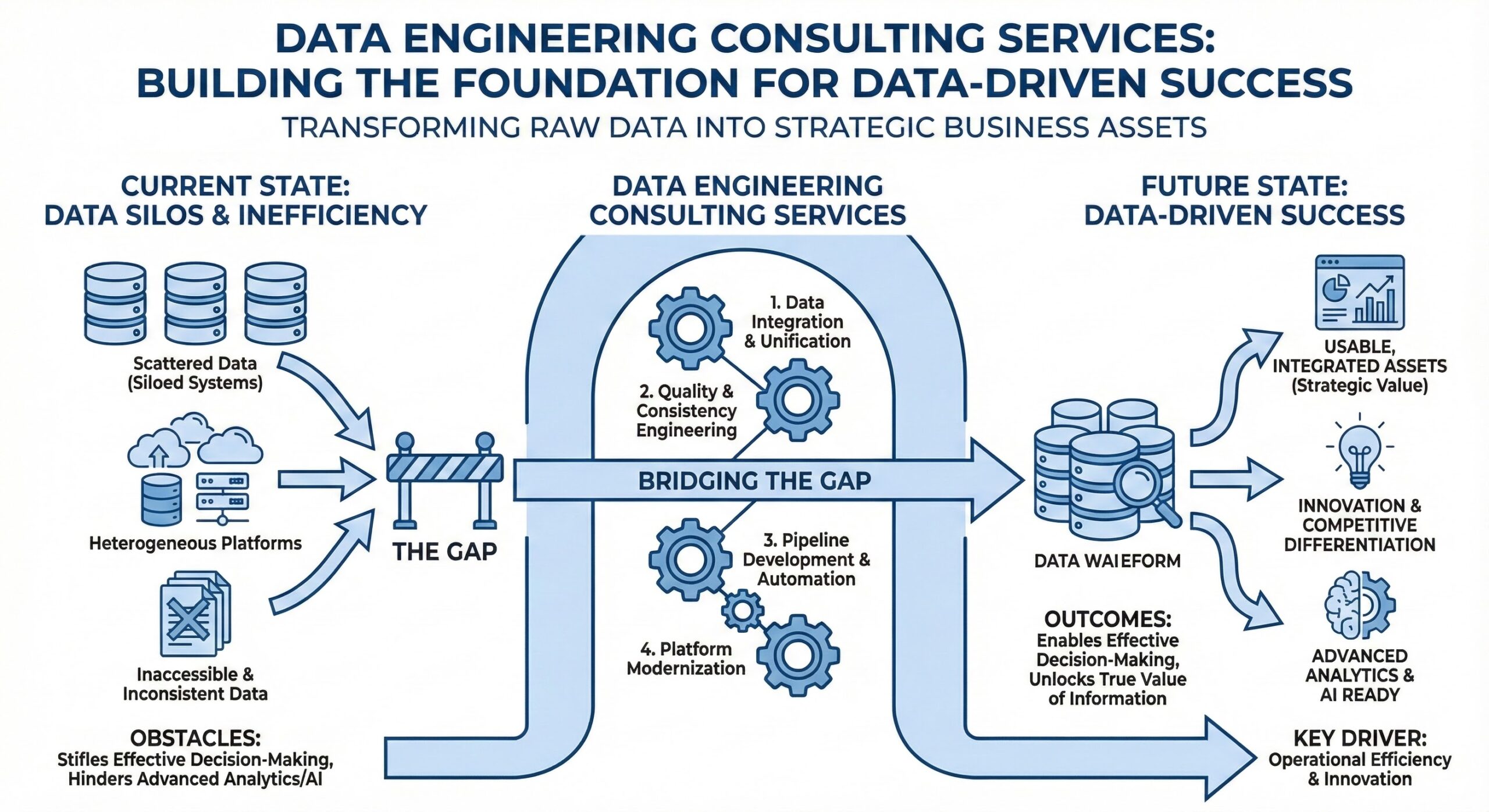
MinervaDB designs, builds, and operates the pipelines that move data from transactional systems into analytical, AI, and operational platforms. Our data engineering consulting covers change data capture, streaming and batch processing, lakehouse and warehouse modelling, data quality controls, and 24×7 managed data operations governed by measurable SLOs.
Data Engineering Built on Database-Grade Discipline
Most pipeline failures are database failures in disguise: a CDC connector that cannot keep up with WAL generation, a warehouse model that forces full scans, a sink that silently duplicates rows after a retry. We engineer data platforms from the storage engine upward.
Data engineering at MinervaDB is the discipline of moving data between systems correctly, continuously, and at a known cost. Every pipeline we build has an explicit contract: which source tables and topics it reads, what transformations it applies, how late data and schema drift are handled, what freshness and completeness the consumers can rely on, and what it costs per day to run. That contract is what we monitor, alert on, and report against once the pipeline is in production.
The practice sits between our database consulting and our analytics and data warehousing work. Our engineers have operated the source systems (PostgreSQL, MySQL, MariaDB, SQL Server, Oracle, MongoDB) and the serving systems (ClickHouse, Snowflake, BigQuery, Redshift, Databricks) for years, so we know how a logical replication slot behaves under a long-running transaction, why a MergeTree sort key decides whether a dashboard renders in 200 ms or 20 s, and what a Snowflake clustering key really costs. That depth is what separates data engineering consulting from generic ETL implementation.
Data Engineering Services, End to End
Six engineering domains, delivered as project consulting, managed operations, or embedded engineering.
Pipeline Architecture & Design
Reference architectures for batch, micro-batch, and streaming pipelines with explicit delivery semantics (at-least-once with idempotent sinks, or exactly-once where the stack supports it), partitioning and parallelism plans, backfill and replay procedures, and a capacity model tied to source change rates rather than guesses.
Change Data Capture & Ingestion
Log-based CDC from PostgreSQL (logical decoding, pgoutput), MySQL and MariaDB (binlog, GTID), SQL Server (CDC tables), Oracle (LogMiner, GoldenGate), and MongoDB (change streams) through Debezium, Kafka Connect, Kinesis, or native replication into Kafka topics or directly into the serving layer. We size replication slots, retention, and connector parallelism against measured WAL and binlog volume.
Lakehouse & Warehouse Modelling
Physical data models for ClickHouse (MergeTree family, projections, materialized views), Snowflake, BigQuery, Redshift, and Databricks, plus open table formats (Apache Iceberg, Delta Lake, Apache Hudi) on S3, GCS, or ADLS. Sort keys, partitioning, clustering, and compaction are chosen from query logs, not from vendor defaults.
Orchestration & Transformation
Apache Airflow and Dagster for scheduling and dependency management, dbt for versioned, tested SQL transformations, Apache Spark and Apache Flink for large-scale batch and stateful stream processing. Everything is code-reviewed, environment-promoted, and reproducible from a repository.
Data Quality & Observability
Freshness, volume, schema, and distribution checks at every hop, implemented with dbt tests, Great Expectations, or native warehouse assertions; lineage captured through OpenLineage; and pipeline telemetry (lag, throughput, error rate, cost per run) exported into the same Prometheus and Grafana stack that monitors your databases.
Security, Governance & Compliance
Encryption in transit and at rest, column-level masking and tokenisation for PII in flight, role-based and row-level access on the serving layer, audit logging of every data movement, and retention and deletion workflows that satisfy GDPR, India DPDP, HIPAA, SOC 2, and PCI DSS requirements. Coordinated with our database security services.
How We Engineer a Production Data Pipeline
The same five-stage topology underlies most of our data engineering engagements. What changes per client is the delivery semantics, the serving engine, and the operating envelope.

Ingestion is sized from the source, not the sink. Before a connector is deployed we measure WAL or binlog generation rate (pg_stat_wal, pg_replication_slots, SHOW BINARY LOG STATUS), peak transaction size, and the longest open transaction. Those three numbers determine slot retention, Kafka topic partitions, connector task count, and whether the source needs a dedicated replica for CDC.
Delivery semantics are declared, then tested. Most sinks are at-least-once; correctness therefore comes from idempotent writes keyed on the source primary key and change LSN or GTID, or from ReplacingMergeTree and MERGE patterns on the serving side. We test duplicate and out-of-order delivery deliberately in staging, because production will do it for you otherwise.
Backfill and replay are first-class procedures. Every pipeline ships with a documented, rehearsed way to reload a partition, a day, or a full table without double-counting, and with a runbook that states blast radius and rollback before the first command runs.
- Schema evolution handled through a registry and compatibility rules, with drift alerts before consumers break
- Watermarks and allowed lateness defined per stream, with late-arriving records routed rather than dropped
- Partitioning aligned with the dominant query predicate on the serving engine, verified from query logs
- Cost per run and per GB tracked from day one, with reserved capacity and tiering decisions revisited quarterly
- Infrastructure-as-Code for connectors, topics, DAGs, and warehouse objects, promoted through environments
- Rehearsed failure modes: broker loss, slot overflow, sink unavailability, and orchestrator outage
Engines and Platforms We Engineer Pipelines Around
Vendor-neutral by principle. We will recommend against a platform when it is the wrong fit, including those we support commercially.
Sources: PostgreSQL, MySQL, MariaDB, SQL Server, Oracle, MongoDB
CDC starts with the source engine’s own replication machinery, and each one has failure modes that a connector will not protect you from. PostgreSQL logical slots retain WAL until consumed, so a stalled consumer fills the disk; MySQL binlog retention and GTID gaps decide whether a connector can resume after an outage; SQL Server CDC capture jobs need their own retention tuning; MongoDB change streams depend on oplog window. We operate these engines as part of our PostgreSQL, MySQL, SQL Server, Oracle, and MongoDB practices, so the CDC layer is engineered by people who also own the source.
Serving: ClickHouse, Snowflake, BigQuery, Redshift, Databricks
Serving-layer design is where most analytical cost and latency is decided. On ClickHouse that means ORDER BY keys, partition expressions, projections, and materialized-view topology chosen from system.query_log; on Snowflake it means clustering keys, warehouse sizing, and micro-partition pruning; on BigQuery, partitioning and clustering against slot consumption; on Redshift, distribution and sort keys. Our ClickHouse consulting and cloud database FinOps practices feed directly into this work.
Lakehouse: Iceberg, Delta Lake, Hudi on object storage
Open table formats decouple storage from compute and let Trino, Spark, Flink, ClickHouse, and the cloud warehouses read the same tables. The engineering work is in compaction and snapshot expiry policies, small-file management, catalog choice (Hive, Glue, Nessie, REST), and partition evolution. We treat the lakehouse as a database with its own maintenance calendar, not as a bucket of Parquet files.
Four Ways to Work With Our Data Engineering Team
From a bounded architecture engagement to fully managed data operations under a 24×7 SLA.
| Model | Best for | What you receive |
|---|---|---|
| Pipeline Architecture & Design | New analytics or AI platforms, replatforming from a legacy ETL tool, first move to streaming | Reference architecture, delivery-semantics specification, capacity and cost model, physical data model for the serving engine, migration roadmap |
| Pipeline Performance & Cost Audit | Late dashboards, growing CDC lag, warehouse bills rising faster than data volume, recurring pipeline incidents | Findings report anchored in pipeline and engine telemetry, prioritised remediation plan, tuned connector, orchestration and warehouse configuration |
| Managed Data Operations | Lean data teams that need 24×7 coverage for pipelines and the databases behind them | SLO-backed monitoring of freshness, completeness and lag; incident response under our standard severity matrix; monthly cost and reliability reviews |
| Embedded Data Engineering | Sustained build-out, modernisation programmes, teams that want capability transfer | Senior data engineers integrated with your sprint cadence and roadmap, with documentation and handover as standing deliverables |
Pipelines Operated to the Same Standard as Production Databases
A pipeline that is not monitored, alerted, and reviewed is a pipeline that will fail on the morning of the board meeting. We run data platforms with the operating discipline of our 24×7 Remote DBA practice.
Every managed pipeline carries three SLOs: freshness (maximum age of the newest record in the serving layer), completeness (reconciled row counts or checksums between source and sink per partition), and latency (end-to-end time from source commit to query visibility for streaming paths). Error budgets are tracked against each, and burn-rate alerts route to an engineer, not a dashboard.
Incidents follow the same severity model as our database support: a broken revenue pipeline is an S1 with a 15-minute response target, a degraded but delivering pipeline is an S2, and everything is closed with a written root-cause analysis and a preventive action. Quarterly, we rehearse the failures that matter: broker outage, replication-slot overflow, warehouse credit exhaustion, and orchestrator loss.
- 24×7 monitoring of connector lag, topic backlog, DAG run status, and warehouse queue depth
- Source-to-sink reconciliation jobs with tolerance thresholds agreed per dataset
- Schema-drift detection with consumer impact analysis before deployment
- Patch and upgrade management for Kafka, Connect, Flink, Airflow, and the serving engines
- Monthly cost review: compute per run, storage tiering, reserved capacity, idle warehouses
- Runbooks with verification before and validation after every change

Feature Pipelines, Vector Data Engineering, and Governed RAG
Machine learning and generative AI programmes fail on data plumbing far more often than on models. We build the plumbing.
Feature Pipelines
Point-in-time-correct feature computation from CDC streams and batch history, served through a feature store or directly from ClickHouse and PostgreSQL, with training and serving parity verified rather than assumed.
Vector Data Engineering
Chunking, embedding, and refresh pipelines that keep vector indexes in Milvus, pgvector, or ClickHouse consistent with the source documents, with re-embedding on model change and deletion propagated end to end. See our dedicated vector data engineering practice.
Private, Governed RAG
Retrieval pipelines that run inside your VPC, honour row-level entitlements at retrieval time, log every retrieval for audit, and satisfy GDPR, DPDP, and HIPAA-class obligations. Delivered with our Data Science & AI consulting practice.
Why Enterprises Choose MinervaDB for Data Engineering
We own the source and the sink
Most data engineering firms stop at the connector. Our engineers operate the PostgreSQL, MySQL, SQL Server, Oracle, and MongoDB systems the data comes from and the ClickHouse, Snowflake, BigQuery, and Redshift systems it lands in, so there is no gap in accountability between the database team and the pipeline team.
Vendor-neutral, measurement-driven
We sell no licences and earn no referral fees. Every recommendation names the metric, log, or system table that justifies it, and we will tell you when a streaming platform, a lakehouse, or a particular warehouse is more than your workload needs.
Senior engineers, production posture
Data pipelines are treated as production, mission-critical systems from the first day. Changes are staged and reversible, destructive operations carry confirmation gates, and every procedure states its blast radius and rollback path before execution.
Knowledge transfer by default
Architecture decisions, runbooks, DAG conventions, and data-model rationale are documented and handed over. Your team should be able to operate what we build; if they choose to have us keep operating it, that is a decision, not a dependency.
“A pipeline is a promise about data: how fresh, how complete, how much it costs. Our job is to write that promise down, engineer to it, and prove every day that it is being kept.”
— The MinervaDB Data Engineering Team
Data Engineering Across Data-Intensive Industries
Sector-specific reference material from our engineering team.
Banking & FinTech
Real-time risk, fraud-signal pipelines, regulatory reporting with reconciled completeness. Read data engineering and analytics in banking and FinTech.
Digital Payments
Event-driven transaction streams, settlement reconciliation, and PCI DSS-scoped data movement. Read data engineering in digital payment solutions.
SaaS & Technology
Multi-tenant usage analytics, product telemetry, and customer-facing dashboards at scale. Read data engineering in the SaaS industry.
Gaming
Player-event ingestion at high fan-in, session analytics, and live-ops experimentation pipelines. Read data engineering in the gaming industry.
E-Commerce & Retail
Catalogue, order, and clickstream pipelines that hold up under peak-season traffic. Read data architecture and engineering for e-commerce.
Digital Advertising
Impression and bid-stream ingestion, attribution models, and sub-second reporting. Read our digital advertising data engineering perspective.
How a Data Engineering Engagement Runs
Discover
Inventory of sources, consumers, and existing pipelines; measured change rates, query patterns, and cost baselines; agreed SLO targets and compliance scope.
Design
Reference architecture, delivery-semantics specification, physical data models, capacity and cost model, and a staged migration or build plan with rollback at every phase.
Build & Validate
Infrastructure-as-Code delivery, reconciliation testing against production-shaped data, failure-mode rehearsal, and documented runbooks before cut-over.
Operate & Improve
SLO-governed operations, monthly reliability and cost reviews, continuous tuning, and knowledge transfer until your team is comfortable owning the platform.
Data Engineering Consulting: Frequently Asked Questions
What does MinervaDB’s data engineering consulting include?
Pipeline architecture and design, change data capture and ingestion, lakehouse and warehouse data modelling, orchestration and transformation (Airflow, Dagster, dbt, Spark, Flink), data quality and observability, and security and governance controls. Each can be delivered as a bounded project, an audit, embedded engineering, or 24×7 managed data operations.
Which source databases and serving platforms do you support?
Sources: PostgreSQL, MySQL, MariaDB, Microsoft SQL Server, Oracle, IBM Db2, MongoDB, Cassandra, and application event streams. Serving: ClickHouse, Snowflake, BigQuery, Amazon Redshift, Databricks, Trino, Milvus, and lakehouse tables on Apache Iceberg, Delta Lake, or Hudi over S3, GCS, ADLS, or MinIO. Streaming: Apache Kafka, Kinesis, RabbitMQ, and managed equivalents such as Confluent and MSK.
Do you build streaming pipelines or only batch ETL?
Both, and usually a combination. Log-based CDC through Debezium and Kafka gives sub-minute freshness for operational analytics; batch and micro-batch paths through Spark, dbt, or native warehouse loads remain the right tool for large historical reprocessing and cost-sensitive workloads. The choice is made per dataset from measured freshness requirements and change rates, not from a blanket architecture preference.
How do you guarantee that data in the warehouse matches the source?
Delivery semantics are declared per pipeline and enforced with idempotent sinks keyed on primary key and LSN or GTID, or with deduplicating table engines on the serving side. Scheduled reconciliation jobs compare row counts and checksums per partition between source and sink, and completeness is one of the three SLOs we report against in managed operations.
Can you take over pipelines built by another team or vendor?
Yes. Takeover starts with a discovery and audit phase that documents every pipeline, its consumers, its failure history, and its cost, then stabilises the highest-risk paths before any modernisation work begins. We frequently inherit Airflow, Kafka Connect, and warehouse estates with little or no documentation.
How does data engineering relate to your Remote DBA and analytics services?
Data engineering sits between them. Our database consulting and Remote DBA practices operate the source systems; our analytics and data warehousing and Data Science & AI practices consume what the pipelines deliver. One team, one accountability chain from transaction commit to dashboard or model.
Let’s Engineer Data Pipelines Your Business Can Rely On
Talk to a MinervaDB principal data engineer about your ingestion, warehouse, or data operations challenge. The first conversation is always with an engineer, never a salesperson.
Schedule a Consultation → Download the MinervaDB Corporate Flyer (PDF) →
Data Engineering Resources from MinervaDB
- Vector Data Engineering: full-stack vector data platforms with SLAs
- Data Strategy and Analytics
- Data Engineering and Analytics in Banking and FinTech
- Data Architecture, Engineering, and Operations for Digital Advertising Networks
- Mastering MySQL Schema Changes with gh-ost
- Compound Wildcard Indexes in MongoDB 7.0
- GreenPlum Consultative Support (24×7)
- The Ultimate Guide to Database Corruption: Prevention, Detection, and Recovery
- Data engineering (Wikipedia)
- Debezium documentation