Database Consulting Services for Every Engine Your Business Runs On, Delivered by the Engineers Who Operate Them
MinervaDB database consulting services cover the whole estate a modern enterprise actually runs: PostgreSQL, MySQL, MariaDB, Microsoft SQL Server, Oracle and Exadata, IBM Db2, MongoDB, SAP HANA, ClickHouse, Trino, Apache Cassandra, Apache Kafka, Redis, Valkey and Milvus, plus every major cloud DBaaS on AWS, Azure and Google Cloud. One team delivers architecture, performance engineering, high availability, migrations and security, backed by 24×7 consultative support and remote DBA services with S1 response in 15 minutes. Vendor-neutral by principle: we recommend against an engine when it is the wrong fit, including the ones we sell services for.
How MinervaDB Database Consulting Services Are Structured
Three delivery modes, one engine roster, one measurement discipline. Most customers start with one and add the others as the estate grows.
Consulting Engagements
Bounded, written engagements: architecture and schema reviews, performance engineering, capacity planning and right-sizing, high-availability and disaster-recovery design, version upgrades, cloud and cross-engine migrations, and licence cost reduction on Oracle, SQL Server and Db2. Every recommendation names the metric, catalog view or execution plan that justifies it, with current-versus-proposed values, restart-versus-reload requirements, blast radius and a rollback path.
24×7 Consultative Support
Named senior engineers on call for production estates, not a ticket queue. Severity 1 incidents are answered within 15 minutes, S2 within 12 hours, S3 within 24 hours and S4 within 48 hours. Each incident closes with a root-cause analysis and a preventive action, because the point of database consulting services on a support contract is that the same outage does not happen twice.
Remote DBA and Managed Services
Follow-the-sun operations for estates that need patching, backup and restore drills, replication health, capacity, security posture and monthly reviews handled as a service. Our PostgreSQL remote DBA services, MySQL remote DBA services and MariaDB remote DBA services run under SLOs on availability, replication lag, backup freshness and restore time, and the same operating model covers every engine below.

Technology stack
Depth areas per engine, with the version lines we support in production today. Version-sensitive guidance is always confirmed against your exact server version before it is written into a deliverable.
PostgreSQL
Autovacuum and bloat management, transaction-ID wraparound prevention, streaming and logical replication, Patroni high availability with etcd, pgBackRest point-in-time recovery, PgBouncer pooling, Citus sharding, PostGIS, pgvector and TimescaleDB. Our PostgreSQL database consulting services follow the PostgreSQL versioning policy for the 14 to 18 lines and start from pg_stat_statements, pg_stat_io and pg_stat_replication, and every plan change is justified with EXPLAIN (ANALYZE, BUFFERS) before and after.
MySQL and MariaDB
Our MySQL and MariaDB database consulting services cover InnoDB buffer pool, redo and flushing tuning, Group Replication and InnoDB Cluster, Galera and MaxScale on MariaDB, ProxySQL routing, online schema change with gh-ost and pt-online-schema-change, XtraBackup and Mariabackup pipelines, and upgrades across MySQL 8.0 end of life to 8.4 LTS or 9.7 LTS and MariaDB 10.6 to 11.8 or 12.3. Evidence comes from performance_schema, the sys schema and SHOW ENGINE INNODB STATUS.
Microsoft SQL Server and Azure SQL
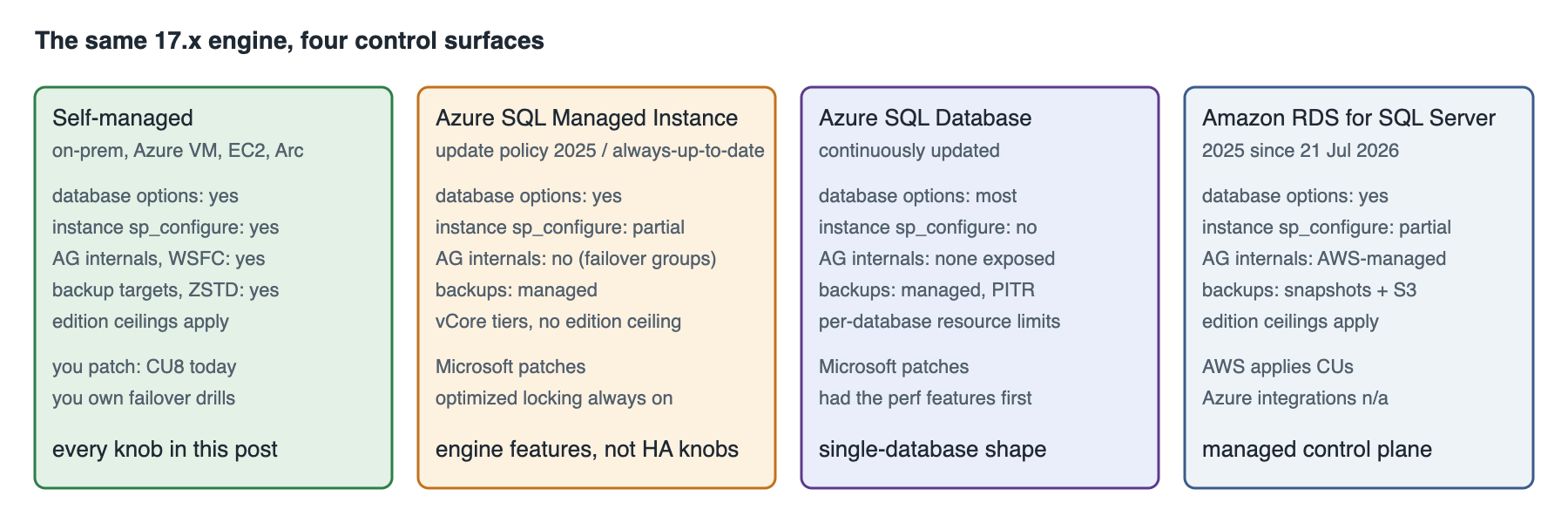
SQL Server database consulting services here cover Always On availability groups and failover cluster instances, Query Store regression control, optimized locking and tempdb governance on SQL Server 2025, index and statistics strategy, columnstore for reporting, and migrations to Azure SQL Database, Azure SQL Managed Instance or Amazon RDS for SQL Server. Wait statistics from sys.dm_os_wait_stats and Query Store runtime data decide the order of work.
Oracle Database and Exadata
Oracle database consulting services span Release Update patching, CDB and PDB operations, RAC, ASM, Data Guard and GoldenGate, AWR and ASH based performance engineering, SQL Plan Management, Exadata offload audits, and licence cost optimization on Enterprise Edition options and packs. When the business case points away from Oracle, the same team runs the Exadata-to-PostgreSQL migration described in the migration paths below.
IBM Db2, LUW and z/OS
Two disciplines, one practice. Db2 LUW: bufferpools and STMM, BLU columnar, pureScale, HADR with Pacemaker, MON_GET_* monitoring, runstats and reorg discipline, 11.5 to 12.1 upgrades and RDS for Db2. Db2 for z/OS: data sharing, DSNZPARM, utilities, plans and packages, function levels and the Db2 12 to Db2 13 migration wave, with the systems-programmer boundary agreed up front.
MongoDB
MongoDB database consulting services cover shard-key design and resharding, replica-set topology and write concern, WiredTiger cache and checkpoint tuning, index cardinality and query-shape analysis from the profiler and $currentOp, Percona Backup for MongoDB, and Atlas versus self-managed decisions on MongoDB 8.x including config shards and targeted mirrored reads.
SAP HANA
SAP HANA database consulting services address column-store and delta-merge behaviour, memory allocation limits, unloads and NSE warm data, plan-cache and M_ view based performance engineering, workload management, backint and storage-snapshot backups, HANA System Replication modes and takeover, scale-out host auto-failover, MDC tenant operations, and SPS and revision lifecycle with SAP Notes discipline, within the Basis-versus-DBA boundary your SAP team already runs.
ClickHouse
MergeTree sort keys, partitioning, index granularity, skip indexes, projections and materialized-view topology; ReplicatedMergeTree with ClickHouse Keeper sizing; Kafka and Debezium ingestion; S3 tiering; and migrations into ClickHouse from Redshift, Snowflake, BigQuery, Druid, Elasticsearch and Vertica. Real-time analytics engagements route to our sister brand ChistaDATA, with system.query_log, system.parts and EXPLAIN PIPELINE as the evidence base.
Trino
Trino database consulting services cover federated SQL across PostgreSQL, MySQL, ClickHouse, Iceberg, Delta Lake, Hive and object storage: catalog and connector design, coordinator and worker sizing, memory and spill configuration, resource groups, dynamic filtering, and the decision of which queries belong in Trino and which belong in the engine underneath.
Apache Cassandra and Apache Kafka
Cassandra 5.0 data modelling by query, partition sizing, compaction strategy selection, repair and tombstone hygiene, multi-datacenter replication and Astra versus self-managed. Kafka 4.x on KRaft: partition and replication design, producer and consumer tuning, exactly-once semantics, tiered storage, Connect and Debezium change data capture, and Confluent versus open-source operating models.
Redis and Valkey
Redis and Valkey database consulting services cover data-structure modelling and keyspace design, memory encodings and eviction, RDB and AOF durability trade-offs, Sentinel and Cluster topologies, I/O threading and latency engineering on Redis 8.x and Valkey 9.x, ElastiCache, MemoryDB and Memorystore mapping, and Redis-to-Valkey migrations driven by the licensing change. INFO, LATENCY and SLOWLOG are read before a single parameter moves.
Milvus and Vector Search
Vector database consulting services on Milvus cover collection and index design (HNSW, IVF, DiskANN), segment and compaction behaviour, hybrid search with scalar filters, Milvus 2.x cluster sizing on Kubernetes, and the honest comparison with pgvector on PostgreSQL for estates where one engine is enough. Delivered alongside our private, in-VPC generative AI and RAG practice.
Cloud Database Consulting Services on AWS, Azure and Google Cloud
Managed services change what you can tune and what you pay for. We know the divergence between each managed service and the open-source engine underneath it, and we design around it.
Amazon Web Services
AWS database consulting services for Amazon RDS and Aurora (PostgreSQL- and MySQL-compatible), DynamoDB, ElastiCache, MemoryDB, Keyspaces and Redshift. Architecture, migration, parameter-group engineering, Performance Insights and CloudWatch based tuning, and cost reduction through right-sizing, storage-class choices and reserved capacity. See our Amazon RDS support and Redshift consulting pages.
Microsoft Azure
Azure database consulting services for Azure SQL Database, Azure SQL Managed Instance, Azure Database for PostgreSQL and MySQL flexible servers, Cosmos DB and Azure Cache for Redis. Service-tier selection, Hyperscale and Business Critical trade-offs, log-rate governor and DTU-versus-vCore economics, and migrations from on-premises SQL Server with Always On cut-over plans.
Google Cloud
Google Cloud database consulting services for Cloud SQL, AlloyDB, Spanner, Bigtable, Memorystore and BigQuery. AlloyDB columnar engine and read-pool design, Spanner schema and interleaving, BigQuery slot and storage cost control, and portable architectures that do not trap you in one provider. See our AlloyDB and BigQuery consulting pages.
MongoDB Atlas, Confluent, DataStax Astra, ClickHouse Cloud, Redis Cloud
Each vendor cloud runs a variant of the engine with its own feature set, limits and bill. We advise on when the managed variant is worth it, when self-managed on Kubernetes is cheaper and more capable, and how to keep an exit path open in both directions.
Snowflake, Databricks, Delta Lake and Apache Iceberg
Warehouse and lakehouse design that works with your operational databases rather than beside them: CDC from PostgreSQL, MySQL, Oracle and SQL Server into Iceberg or Delta tables, Trino and ClickHouse serving tiers, and the FinOps discipline that keeps warehouse spend proportional to value. See Snowflake and Databricks consulting.
Cloud Database FinOps
Instance families, storage tiers, IOPS provisioning, licence-included versus bring-your-own, commitment strategy and idle-resource retirement, measured from the provider's billing export and the engine's own utilisation metrics. Our cloud database optimization and FinOps practice routinely finds double-digit savings without touching application code.

How the Database Consulting Services Measure Before They Recommend
A recommendation without a metric behind it is an opinion. Every engagement follows the same six steps, and the customer keeps the evidence.
We start with a baseline of seven to fourteen days of production telemetry taken from the engine's own catalog and monitoring views, not from a dashboard screenshot: p95 and p99 latency, wait events, replication lag, cache hit ratios, I/O saturation and growth rate. The saturated resource is ranked before anything is tuned, because a database is only as fast as whichever of CPU, memory, I/O, locks or the query plan hits the wall first.
Each proposed change is written with the exact parameter, its current and proposed value, the unit, whether it needs a reload or a restart, its blast radius and its rollback path. Changes are tested on a replica or a staging clone under a replayed or synthetic workload with pgbench, sysbench, HammerDB or valkey-benchmark, then applied through a runbook with a verification query before, a validation query after and a confirmation gate on any destructive step.
After the change, the same metrics are re-read and the before-and-after numbers go into the report, including what did not improve. Illustrative figures are labelled as illustrative and never presented as benchmarks. The customer keeps the baseline, the runbook, the numbers and a register of what is still open, so the next engineer, ours or yours, starts from evidence rather than from memory.
This is also why our database consulting services treat every system as production and mission-critical unless told otherwise: staged, reversible changes applied replica-first, with the standing caveat that everything is tested before it reaches production and that a tested disaster-recovery posture is maintained throughout.

Migration Paths the Database Consulting Services Cover
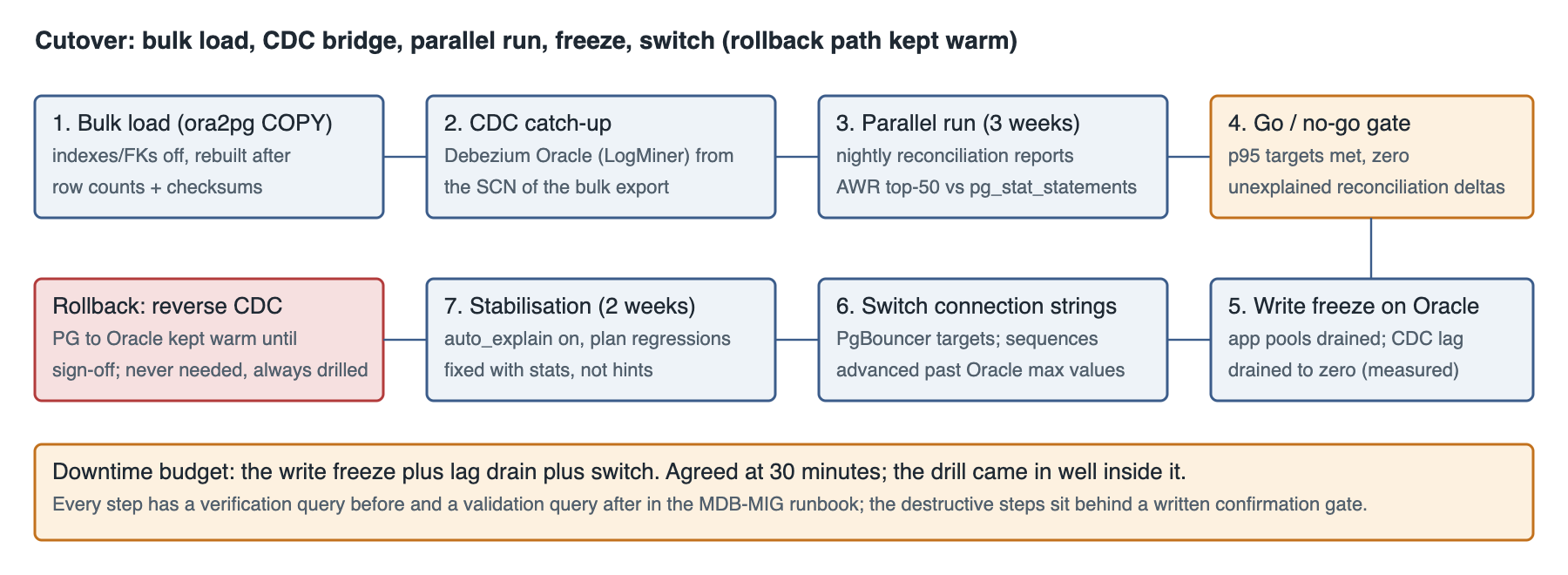
Cross-engine, cross-cloud and version migrations, each with a rehearsed cut-over, a measured go/no-go gate and a rollback that has actually been tested.
| From | To | Typical driver | How we de-risk it |
|---|---|---|---|
| Oracle, Exadata | PostgreSQL 16–18, self-managed or AlloyDB, Aurora, RDS | Licence cost, hardware refresh, cloud strategy | PL/SQL inventory and conversion plan, dual-run with CDC, workload replay, application-level cut-over rehearsal |
| Db2 LUW, Db2 for z/OS | PostgreSQL, or Db2 12.1 / Db2 13 in place | Mainframe cost, end of support, skills | Offload by workload class, CDC to PostgreSQL or ClickHouse for reporting, systems-programmer boundary agreed up front |
| SQL Server on-premises | SQL Server 2025, Azure SQL MI, RDS for SQL Server | End of extended support, data-centre exit | Query Store baseline carried across, compatibility-level staging, Always On based near-zero-downtime cut-over |
| MySQL 5.7 / 8.0 | MySQL 8.4 LTS, 9.7 LTS, MariaDB 11.8 / 12.3, Aurora | End of life, features, cost | Replication-based upgrade with read-only validation window, GTID handling on MariaDB, ProxySQL or MaxScale switch-over |
| Redis | Valkey 9.x, ElastiCache or MemoryDB for Valkey | Licensing change, cost | Replica-based migration, command and module compatibility audit, latency comparison under production traffic |
| Redshift, Snowflake, BigQuery, Druid, Elasticsearch | ClickHouse 26.x LTS, self-managed or ClickHouse Cloud | Query latency, cost per query, real-time ingestion | Schema and sort-key design from query logs, parallel load, dashboard-by-dashboard validation with ChistaDATA |
| Cassandra, DynamoDB, MongoDB | Each other, or PostgreSQL where the access pattern allows | Fit, cost, operational load | Access-pattern inventory, data-model redesign by query, dual-write or CDC with reconciliation counts |
| Any engine | Kubernetes with operators, or back to VMs | Platform standardisation | Percona Operators, CloudNativePG or vendor operators; storage-class and failover drills before the first production workload |
High Availability and Disaster Recovery, Engineered per Engine
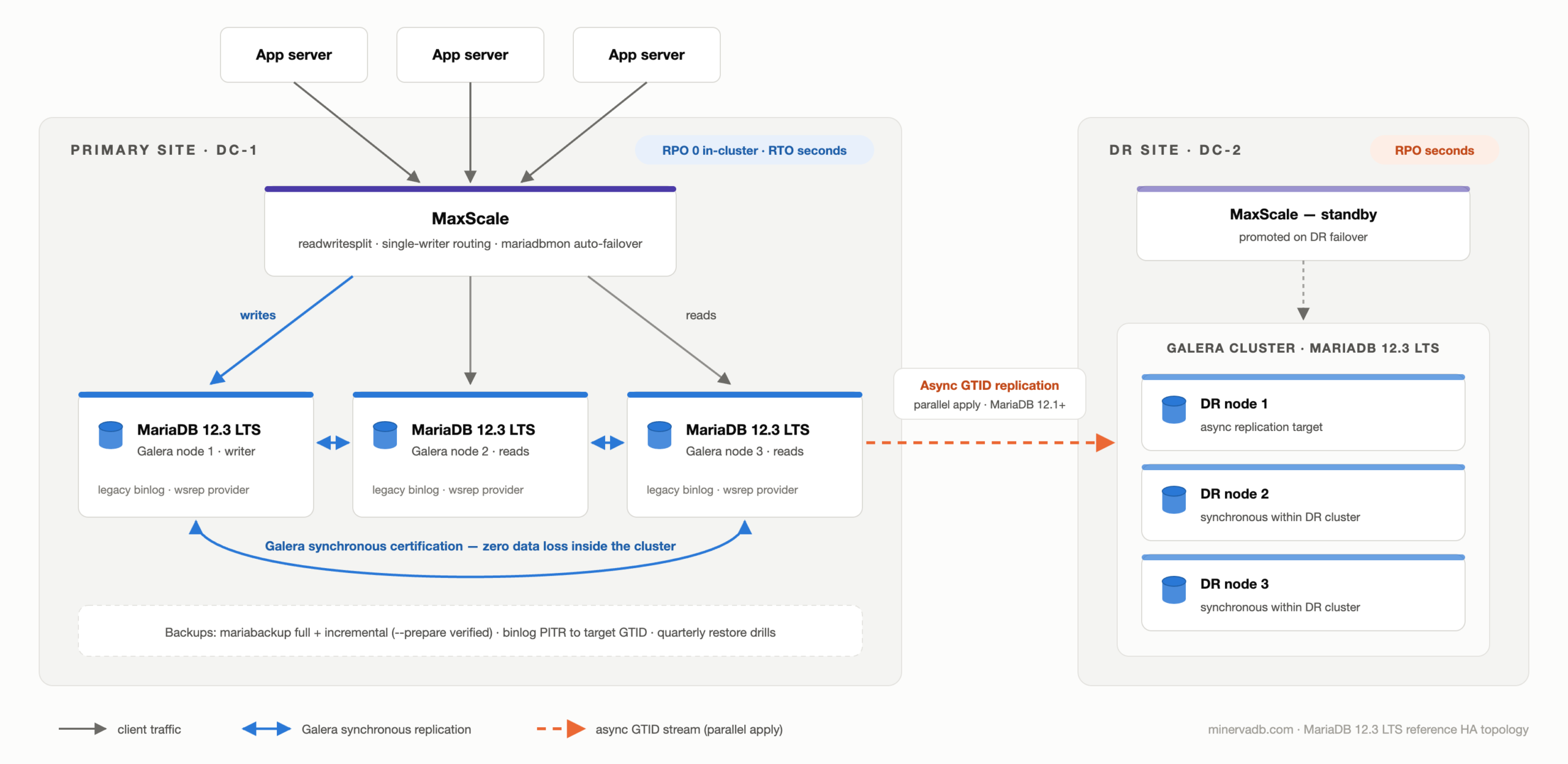
RPO and RTO are business numbers first. We match the topology to them, then prove it with quarterly restore and failover drills.
Patroni, Always On, Galera, Data Guard, HADR
Relational high-availability database consulting services: PostgreSQL with Patroni and etcd, pgBackRest and synchronous standbys where zero data loss is required; SQL Server Always On availability groups across zones; MariaDB Galera with MaxScale and a delayed replica for operator error; Oracle Data Guard with fast-start failover; Db2 HADR with Pacemaker. Each topology comes with a written failover runbook and an expected RTO measured in a drill, not estimated.
Replica Sets, Multi-DC Rings, Keeper Quorums, Cluster Mode
Distributed-system database consulting services: MongoDB replica sets and sharded clusters with majority write concern; Cassandra multi-datacenter rings with rack-aware placement; ClickHouse ReplicatedMergeTree with correctly sized Keeper quorums and cross-region replication; Redis and Valkey Sentinel or Cluster with dual-channel replication; Kafka with rack-aware replicas and tiered storage. Failure modes are exercised deliberately, including a full availability-zone loss.
Database Consulting Services: Engagement Models, Response Times and What You Receive
Pay-as-you-go consulting, fixed-scope projects, 24×7 consultative support subscriptions and remote DBA retainers. No advances, no long-term lock-in, and every hour reported.
| Model | Best for | Coverage | What you receive |
|---|---|---|---|
| Consulting engagement | Architecture review, performance crisis, migration, upgrade, licence audit | Fixed scope or hourly, onsite or remote | Written findings ranked P0/P1/P2, runbooks, configuration files, before/after evidence |
| 24×7 consultative support | Production estates that need named engineers on call | S1 15 min · S2 12 h · S3 24 h · S4 48 h, follow-the-sun | Incident response, root-cause analysis, preventive actions, quarterly health reviews |
| Remote DBA services | Estates without a full-time DBA, or teams that want operations off their plate | Continuous, SLO-governed | Patching, backups and restore drills, replication and capacity management, security posture, monthly reports |
| Health check | A second opinion on one or more instances before a launch or an audit | Per instance, one to two weeks | Configuration, expensive SQL, index, capacity, HA and security findings with a prioritised plan |
| Emergency and data recovery | Outage, corruption, dropped objects, broken replication, even for non-customers | Immediate, pay per incident | Stabilisation, recovery of data from files, backups or media where possible, post-incident report |
Discover
Every database consulting services engagement opens with an inventory of engines, versions, topologies and cloud services; the incidents of the last twelve months; the SLOs the business actually needs; the licences and bills in play.
Baseline
Seven to fourteen days of telemetry from each engine's own views, ranked by saturated resource, with the top queries, waits and growth curves documented.
Deliver
Prioritised findings, runbooks with expected output at every phase, staged reversible changes applied replica-first, and drills that prove the failover and the restore.
Operate and Improve
24×7 support or remote DBA coverage under SLOs, monthly reviews against the baseline, and knowledge transfer until your team owns the platform.
Security Posture Built into Every Engagement
Encryption, access, audit and evidence, mapped to the frameworks your auditors ask about.
Every engine our database consulting services cover is hardened against the same control set: TLS in transit and encryption at rest, least-privilege roles and row- or column-level policies where the engine supports them, credential rotation with secrets held outside the database, audit logging shipped to a system the DBA cannot edit, and backup encryption with restore drills that prove the key management works. Credentials in our deliverables are always placeholders; nothing is hard-coded.
Findings are mapped to SOC 2, ISO 27001, GDPR, India DPDP, HIPAA, PCI DSS and SOX controls so the security review and the compliance evidence come out of the same engagement. Our database security services extend this into a subscription with a versioned posture report per instance, and our data governance consulting covers lineage, retention and deletion evidence above the database layer.
- Vendor-neutral and independent: we hold no reseller agreements that would bias an engine, cloud or licence recommendation.
- Principal-level engineers only, no AI agents on customer systems, and no customer data, credentials, schemas or query text placed in third-party AI tools.
- Every destructive step in a runbook carries a confirmation gate, a verification query before and a validation query after.
- Findings delivered in 48 to 72 hours for health checks and emergency engagements, prioritised P0, P1 and P2.
Questions Customers Ask Before Engaging Database Consulting Services
Which engines do MinervaDB database consulting services cover?
PostgreSQL, MySQL, MariaDB, Microsoft SQL Server and Azure SQL, Oracle Database and Exadata, IBM Db2 LUW and z/OS, MongoDB, SAP HANA, ClickHouse, Trino, Apache Cassandra, Apache Kafka, Redis, Valkey and Milvus, plus the managed database services on AWS, Azure and Google Cloud and the vendor clouds MongoDB Atlas, Confluent, DataStax Astra, ClickHouse Cloud and Redis Cloud. Lakehouse platforms (Snowflake, Databricks, Delta Lake, Apache Iceberg) are covered through our data engineering practice.
Do you work onsite or remotely?
Both. Almost all technical work is delivered remotely by a follow-the-sun team; strategic architecture sessions and cut-over weekends are delivered onsite when the customer prefers. We have delivered onsite in 46 cities.
What does 24×7 consultative support include and how fast is the response?
Named senior engineers on call around the clock for the engines under contract. Severity 1 (production down or data at risk) is answered within 15 minutes, S2 within 12 hours, S3 within 24 hours and S4 within 48 hours. Every incident closes with a root-cause analysis and a preventive action, and quarterly reviews track the estate against its baseline.
How are remote DBA services different from support?
Support responds when you call; remote DBA services run the estate. Patching, backups and restore drills, replication health, capacity, security posture and monthly reporting are handled continuously under SLOs on availability, replication lag, backup freshness and restore time. Many customers combine both.
Will you recommend against an engine or a cloud service you sell services for?
Yes, and we do so regularly. Vendor neutrality is the reason customers trust the recommendation. If PostgreSQL is the wrong fit for a workload, or a managed service costs more than it returns, the report says so and shows the measurement behind it.
How do database consulting services engagements start and what do they cost?
They start with a scoping call with an engineer, never a salesperson, followed by a written scope with either a fixed price or an hourly estimate. Consulting is billed for hours worked with no advances; support and remote DBA services are subscriptions priced per engine and per instance. Emergency help is available per incident, including for organisations that are not yet customers.
Talk to the Engineers Who Will Actually Do the Work
Tell us which engine, which incident or which migration is in front of you. The first conversation is with a principal engineer, the scope is written before any work starts, and every recommendation comes with the evidence behind it.
Book a Scoping Call → Email contact@minervadb.com → Call +1 (844) 588-7287 →Service Pages and Guides Behind These Database Consulting Services
- PostgreSQL Consulting, 24×7 Support and Remote DBA
- MySQL Consulting
- MariaDB Consulting
- SQL Server Support and Consulting
- Oracle Database, Exadata and OCI Consulting
- IBM Db2 LUW and z/OS Consulting
- MongoDB Consulting
- SAP HANA Consulting and Support
- ClickHouse Consulting
- Apache Cassandra Consulting
- Apache Kafka Consulting
- Redis and Valkey Support
- NoSQL Consulting
- Amazon RDS Support
- Cloud Database Optimization and FinOps
- Data Modernization
- Database Security Services
- Data Engineering Consulting
- Valkey 9.1.2 Performance and Scalability Improvements
- Oracle Exadata to PostgreSQL 18: an Airline Operations Migration