Redis 8.8 (GA 2026-05-25, current patch 8.8.1) is the first Redis release in a while that changes the economics of running a cache tier in front of distributed PostgreSQL, rather than just making the cache marginally faster. Three things landed across the 8.2–8.8 window that matter for distributed PostgreSQL query performance in multi-tenant SaaS platforms: a rebuilt key-value memory layout that fits meaningfully more cache into the same node, first-class hot-key and hot-slot telemetry that finally makes tenant skew measurable instead of anecdotal, and a set of atomic commands (INCREX, SET IFEQ) that retire the Lua scripts most of us have been carrying around for rate limiting and stampede control since 2015.
This post walks through each change, pins it to a version, and shows where it lands in a cache-aside architecture in front of Citus or a sharded PostgreSQL estate.
Why distributed PostgreSQL query performance depends on the cache tier
Distributed PostgreSQL — whether that is Citus, a hand-sharded fleet, or a Patroni cluster with a stack of read replicas — has a cost profile that punishes exactly the query shapes SaaS dashboards generate. A cross-shard aggregate fans out to every worker, pays coordinator merge cost, and holds a connection on each node for the duration. Per-tenant "count of X this month" queries repeat with near-identical parameters thousands of times an hour. And connection pressure compounds it: every PostgreSQL backend is a process, so ten thousand app-server connections against a coordinator is a problem PgBouncer mitigates but does not eliminate.
The standing answer is a look-aside cache in front of the coordinator, and Redis has been the default choice for that role for a decade. What has changed is not the pattern — it is how much of the pattern's operational pain Redis 8.x removes. We cover the fundamentals of the PostgreSQL side in our earlier post on PostgreSQL caching and shared_buffers tuning; this one is about what sits in front of it.
What changed in Redis 8.2–8.8 that actually matters
More cache per gigabyte: the kvobj layout (Redis 8.2)
Redis 8.2 unified key, value, and TTL into a single allocation (the kvobj work). Redis reports up to 37% lower per-key overhead for short string keys [vendor-reported; not reproduced in our lab]. Query-result caches for SaaS workloads are dominated by exactly that shape — millions of small keys like t:4711:rpt:mrr:2026-08 with TTLs — so the practical effect is a higher hit ratio at the same maxmemory, which converts directly into fewer queries reaching PostgreSQL — and Redis 8.8 inherits the layout unchanged.
Validate on your own dataset with MEMORY USAGE on representative keys before and after upgrade, and watch keyspace_hits / keyspace_misses in INFO stats across the cutover. Any capacity model built on pre-8.2 per-key arithmetic is stale.
Batched prefetch for MGET and HGETALL (Redis 8.8)
Dashboard rendering rarely fetches one key. A typical SaaS page issues an MGET across 20–50 cached fragments. Redis 8.8 added batched memory prefetch on the MGET/MSET and hashtable-encoded HGETALL paths, and Redis 8.4 introduced the lookahead parameter (default 16 commands) for pipelined workloads. Neither ships with published latency numbers, so treat them as free wins to be confirmed: if INFO commandstats shows MGET or HGETALL dominating your call mix, A/B the lookahead default of 16 against 32 on Redis 8.8 and judge it on INFO latencystats p99, not on throughput alone.
Tenant skew becomes measurable: HOTKEYS and CLUSTER SLOT-STATS (Redis 8.6 / 8.2)
Every multi-tenant platform has a whale tenant, and in a clustered cache that tenant concentrates on one shard. Before this window, proving it meant sampling with MONITOR on a loaded primary — something nobody should do twice. Redis 8.6 added built-in HOTKEYS detection, and 8.2 added CLUSTER SLOT-STATS (per-slot key count, CPU time, and network ingress/egress; enable cluster-slot-stats-enabled). Both ship in every Redis 8.8 build, and together they turn "we think tenant 4711 is melting shard 3" into a numbered finding you can act on — usually by giving hot tenants their own hash tags or their own shard.
INCREX: per-tenant rate limiting in one atomic command (Redis 8.8)
The fastest query is the one you refuse, and Redis 8.8 makes refusal a one-liner. Protecting a PostgreSQL coordinator from a runaway tenant or a misbehaving API client has traditionally meant a Lua window-counter script. Redis 8.8's INCREX collapses increment, bounds check, and expiry into a single O(1) command, which removes the script-cache management and the replication edge cases that came with EVALSHA-based limiters. On 8.8+ this is now our default recommendation for API-gateway throttling in front of a database tier.
INCREX ratelimit:{t:4711}:api BYINT 1 UBOUND 500 EX 60 ENX
The reply carries the new counter value and the increment actually applied; an applied increment of 0 means the tenant is over its 500-requests-per-minute budget and the request never reaches PostgreSQL. One caveat for mixed estates: Valkey has no INCREX equivalent as of Valkey 9.1, so keep the Lua limiter anywhere the design must run on both engines.
SET IFEQ: stampede locks without Lua (Redis 8.4)
Cache stampede — a popular key expires and five hundred app workers simultaneously re-run the same expensive cross-shard aggregate — is the classic failure mode of cache-aside in front of distributed PostgreSQL. The fix is single-flight: one worker takes a short lock, recomputes, repopulates; the rest serve slightly stale data or wait. Redis 8.4's SET ... IFEQ/IFNE and DELEX make the compare-and-set idiom native, so the lock acquire/release pair no longer needs a script on Redis 8.8 estates. If you are on 8.4+ and still shipping the Lua CAS, retire it.
Atomic slot migration: reshard the cache during business hours (Redis 8.4)
SaaS cache tiers grow, and pre-8.4 resharding meant the IMPORTING/MIGRATING dance with -ASK redirect storms and multi-key command failures — which is why cache resharding used to be a Saturday-night event. Redis 8.4's CLUSTER MIGRATION replicates the slot and hands ownership over atomically. The client-visible latency event largely disappears, a reshard becomes schedulable, and the mechanism carries forward into Redis 8.8 unchanged. One documented limitation: search and time-series queries may return partial or duplicate results during a migration, so if you run the Query Engine on the same cluster, fence those paths in the runbook.
Reference architecture: cache-aside in front of distributed PostgreSQL
The topology we deploy most often for SaaS platforms is below. Reads go app → client-side cache → Redis 8.8 cluster → PostgreSQL coordinator, with each layer absorbing what the next one would otherwise pay for. Writes go to PostgreSQL first; invalidation flows back either from the application (delete-on-write) or from a CDC pipeline reading logical decoding.
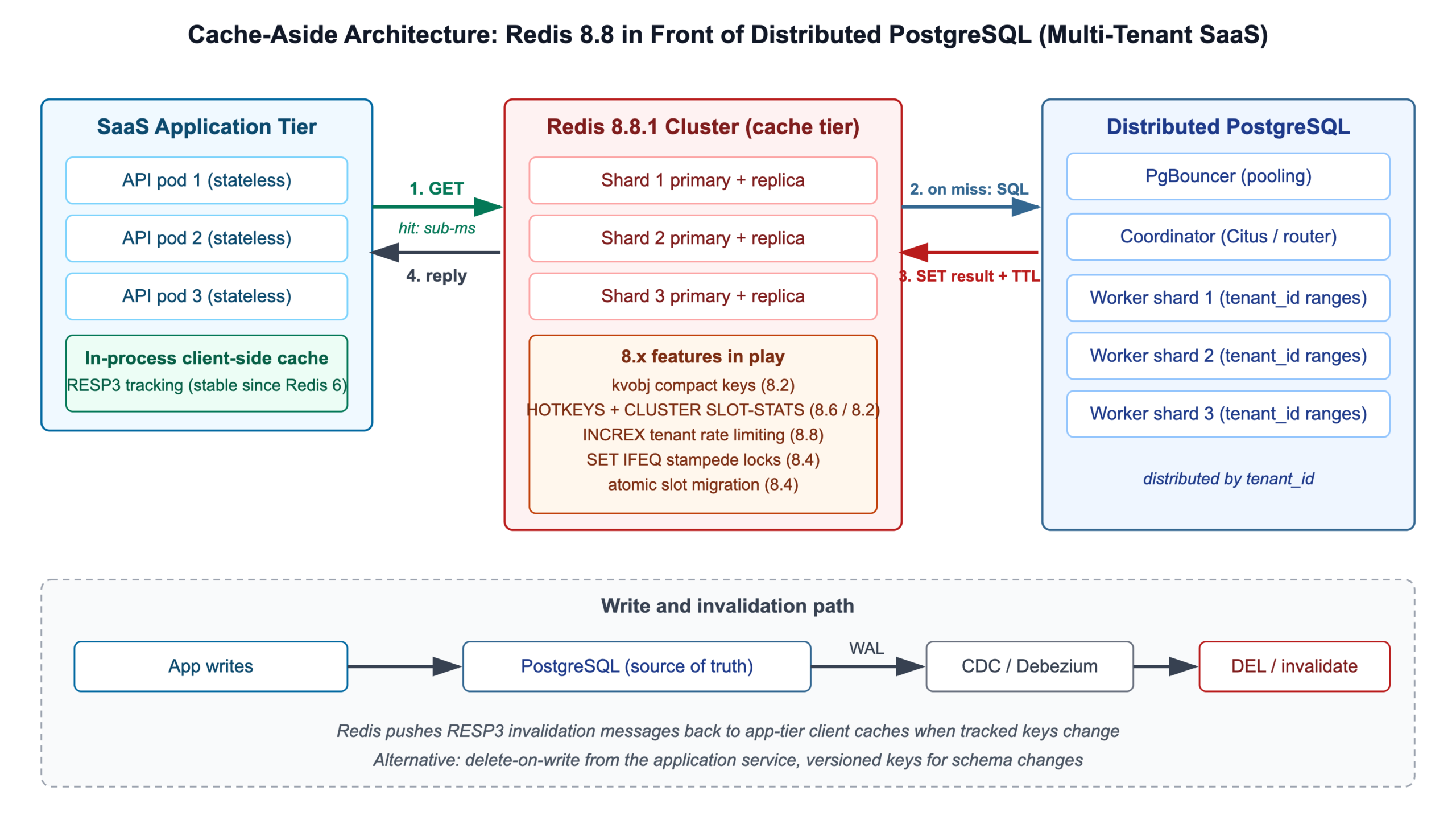
Two design points deserve emphasis. First, server-assisted client-side caching (the RESP3 tracking mechanism, stable since Redis 6 and well supported in current clients) means your hottest keys — feature flags, plan entitlements, tenant metadata — are served from application memory with zero network round trips, and Redis pushes invalidations when they change. In broadcasting mode, subscribe clients to the prefixes they cache (tenant:, flags:) rather than tracking per-connection state on a busy tier.
Second, keyspace design: prefix every key with the tenant ID and use hash tags deliberately. {t:4711}:rpt:mrr:2026-08 keeps one tenant's keys on one cluster slot, which makes multi-key operations work and makes CLUSTER SLOT-STATS attribution per-tenant trivial — but it also concentrates whale tenants, which is exactly what HOTKEYS is there to catch.
A worked example: caching a cross-shard aggregate
Take the query every B2B SaaS dashboard runs — monthly recurring revenue for a tenant, aggregated across an events table distributed by tenant_id:
SELECT date_trunc('month', billed_at) AS billing_month,
       SUM(amount_cents) AS mrr_cents
FROM   billing_events
WHERE  tenant_id = 4711
AND    billed_at >= now() - INTERVAL '12 months'
GROUP  BY 1
ORDER  BY 1;
On a distributed table this is cheap per shard but expensive in aggregate when 40,000 tenants refresh dashboards every morning. The cache-aside wrapper is unremarkable by design — the interesting decisions are the TTL and the stampede lock:
# Read path against Redis 8.8 (Python-ish pseudocode, redis-py 6.x)
key = "{t:4711}:rpt:mrr:v2"
result = r.get(key)
if result is None:
    # single-flight: only one worker recomputes (Redis 8.4+ native CAS)
    if r.set(f"{key}:lock", worker_id, nx=True, ex=15):
        result = run_postgres_query(tenant_id=4711)
        r.set(key, serialize(result), ex=900)   # 15 min TTL
        r.delete(f"{key}:lock")
    else:
        result = wait_and_reread_or_serve_stale(key)
A 15-minute TTL on a revenue rollup is a product decision, not a technical one — write it down and get it signed off. Where the business needs invalidation-on-write instead, drive deletes from the billing service or from a Debezium/logical-decoding pipeline keyed on tenant_id. Version the key (:v2) so schema changes in the serialized payload never require a cluster-wide flush.
Measuring the improvement honestly
A cache tier claim is only as good as its before/after evidence, and the evidence lives on both sides of the boundary. On the PostgreSQL side, pg_stat_statements is the source of truth: snapshot calls, total_exec_time, and mean_exec_time for the cached query fingerprints before enabling the cache, then again after a full business cycle. The win shows up as a collapse in calls, not in mean_exec_time — the queries that still reach PostgreSQL are the cache misses, and they cost the same as ever.
If long-running outliers persist, that diagnosis path is covered in our post on troubleshooting long-running PostgreSQL queries and wait events.
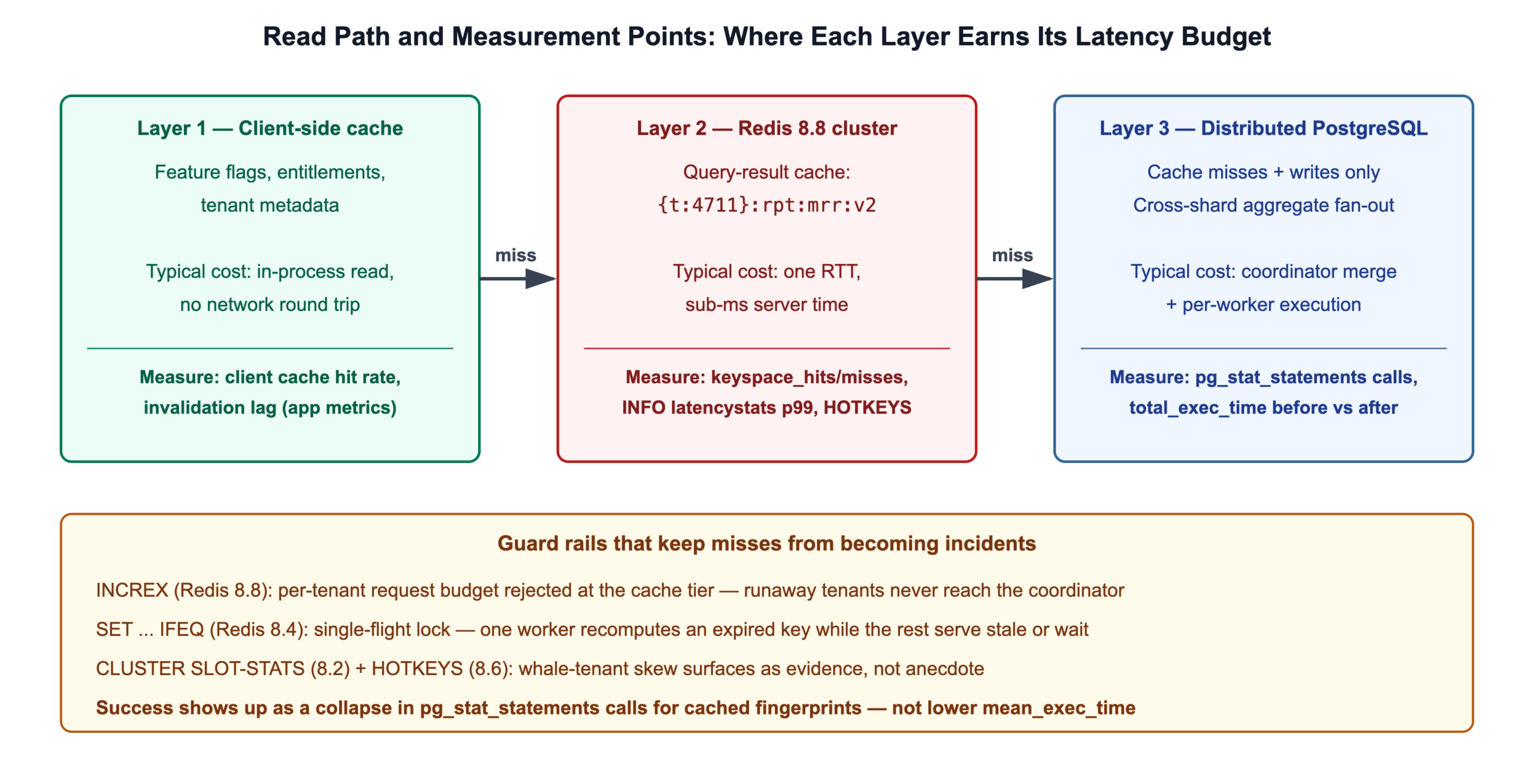
On the Redis 8.8 side, the checklist is short and version-pinned: hit ratio from keyspace_hits/keyspace_misses (INFO stats), tail latency from INFO latencystats and LATENCY LATEST, command mix from INFO commandstats, per-slot tenant attribution from CLUSTER SLOT-STATS (8.2+), hot keys from HOTKEYS (8.6+), and memory attribution from key-memory-histograms (8.6+) instead of sampling with MEMORY USAGE. We keep a fuller methodology in the MinervaDB Redis performance audit framework.
Two illustrative targets we consider healthy for a SaaS query cache, and they are illustrative, not benchmarks: hit ratio above 0.90 on dashboard read paths, and a Redis 8.8 p99 on GET at least two orders of magnitude below the p50 of the underlying PostgreSQL query it fronts.
Where Redis 8.8 does not help
Honest edges, because a cache tier is not a performance amnesty. Write-heavy paths gain nothing — every write still lands in PostgreSQL, and invalidation traffic adds load. Queries with high-cardinality parameters (ad-hoc filters, search) have hit ratios too low to justify the memory. Consistency-critical reads — billing calculation at invoice time, entitlement checks at payment — should go to the coordinator; serving them from cache trades correctness for latency in the wrong place.
And Redis 8.8 remains a cache here, not a system of record: keep aof-load-corrupt-tail-max-size at its safe default posture for anything durable, and state the durability contract in writing. None of this is a Redis limitation; it is the pattern's limitation, and the PostgreSQL side still deserves its own tuning pass — see our PostgreSQL 18 performance tuning guide for that half of the work.
Two non-technical notes belong in any 2026 adoption decision. Redis 8.x is tri-licensed (RSALv2, SSPLv1, or AGPLv3 at your choice); stock unmodified Redis as internal infrastructure triggers no AGPL disclosure obligation, but if your OSS policy carries a blanket AGPL prohibition, have that conversation before the upgrade, not after — and route formal license questions to counsel. And managed services lag: Redis Cloud has historically trailed open source by one to two minors, so confirm Redis 8.8 feature availability with your provider before scoping a design on INCREX or the Array type.
Upgrade stance
Adopt Redis 8.8.1 or later, not Redis 8.8.0 — the July 2026 coordinated patch wave fixed multiple RCE-class issues, several traced to the RESTORE surface (full details in the Redis release notes on GitHub, feature summary in the Redis 8.8 what's-new).
Two operational rules we now apply to every estate: deny RESTORE via ACL for all application users (it is rarely needed outside migration tooling; verify with ACL GETUSER), and note that Redis publishes no EOL calendar for its release lines, so version currency is your policy to enforce, not the vendor's. As always: test in staging first, keep a rollback path, and maintain a tested DR posture before touching a production cache tier — a cold cache in front of a distributed PostgreSQL fleet is itself an incident.
If you want a second pair of eyes on a Redis-in-front-of-PostgreSQL design — keyspace review, capacity model, upgrade plan, or a full audit — this is core territory for MinervaDB's Redis consulting and support practice, and we are happy to argue about TTLs with you.
Running PostgreSQL in production? MinervaDB provides PostgreSQL consulting, 24×7 PostgreSQL support and PostgreSQL remote DBA services as part of its database consulting services.
Running this in production?
MinervaDB provides PostgreSQL Consulting, PostgreSQL Support, PostgreSQL Remote DBA and Redis Support with 24x7 coverage and a 15-minute S1 response. Talk to an engineer.