MinervaDB

Enterprise Database Consulting, 24x7 Support and Remote DBA

  • MinervaDB
    • GCC Data Leadership
    • For CTOs
    • For CIOs
    • Full-Stack Optimization
    • MinervaDB University
    • Partner Network
  • Engineering
    • Data Analytics Platform Engineering
    • Fractional CDO
    • Data Science & AI
    • Cloud FinOps
      • MinervaDB Privacy Policy
    • Data Modernization
    • Databricks
    • Snowflake
    • Microsoft Azure
    • AWS
    • Google Cloud
    • AI and Vector Data
    • MySQL
    • PostgreSQL
    • PostgreSQL on Kubernetes
    • SQL Server Consulting
    • MariaDB Consulting
    • MongoDB Consulting
    • Ticketing System
  • Support
    • Enterprise Support
    • 24/7 Emergency DBA
    • PostgreSQL Support
    • MySQL Support
    • MariaDB Support
    • SQL Server Support
    • Db2 LUW & z/OS Support
    • Oracle Database, Exadata & OCI Support
    • MongoDB Support
    • NoSQL
    • Kafka Support
    • Cloud Native
    • Analytics & DWH
    • Data Security
  • Remote DBA
    • 24*7 Emergency DBA
    • PostgreSQL DBA
    • 24/7 MySQL DBA
    • 24/7 MariaDB DBA
    • NoSQL Services
    • MongoDB Services
  • Blog
    • MinervaDB Blog
  • Careers
  • Contact
    • MinervaDB Contacts
    • Book an Appointment
    • MinervaDB FAQ
    • Cookie Policy
    • MinervaDB Privacy Policy
  • Facebook
    • Data Ops. Geek
  • Twitter
    • @MinervaDB
    • @ShivIyer
    • @ChistaDATA
  • LinkedIn
    • Shiv Iyer
  • GitHub
    • @ShivIyer
HomeDatabase Performance

Database Performance

expensive SQL
Data Reliability Engineering

Expensive SQL on Exadata 26.1: Read the Offload Numbers Before You Build the Index

The Exadata ticket we see most often is not about a slow query. It is about a cluster that runs hot for hours, an IORM plan that somebody keeps re-tuning, and a licence conversation about [...]
Expensive Queries
Azure SQL

SQL Server 2025 Expensive Queries: 7 Proven Ways to Find and Fix Them by Latency and Resource Cost

"Expensive queries" is a phrase that hides two different problems. One is response time: a statement the application waits too long for. The other is resource efficiency: a statement that burns CPU, logical reads and [...]
Index Efficiency
Data Reliability Engineering

Db2 13 for z/OS Index Efficiency: 8 Proven Troubleshooting Techniques

Most index efficiency problems on Db2 13 for z/OS are not I/O problems. They are CPU problems that look like I/O problems from a distance. Index efficiency is measured in getpages, and a four-level index [...]
AlloyDB pricing, internals and FinOps: performance per dollar on Google AlloyDB
AlloyDB

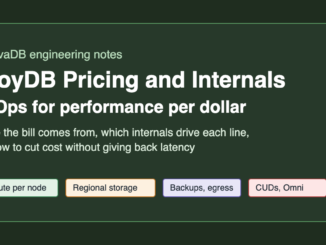
AlloyDB Pricing and Internals: 2026 FinOps Best Practices Guide

AlloyDB pricing is simple to read and easy to get wrong, because every line on the invoice is driven by a piece of the engine's internals that most teams never look at. Compute is billed [...]
AlloyDB
AlloyDB

Google AlloyDB Architecture, Internals and Performance: 2026 Best Practices Guide

AlloyDB is the one managed PostgreSQL service where the interesting part is below the SQL layer. The query engine, catalog, extensions and wire protocol are PostgreSQL (16, 17 and, since 25 March 2026, 18). What [...]
SQL Server 2025
Amazon RDS

SQL Server 2025 Performance, Scalability and High Availability: What Changed On-Premises and in the Cloud

SQL Server 2025 went generally available on 18 November 2025 and, as of this writing, sits at Cumulative Update 8 (build 17.0.4075.5, 13 August 2026). Strip away the AI features that took most of the [...]
Oracle Exadata to PostgreSQL 18 Migration
Case Studies

Oracle Exadata to PostgreSQL 18 Migration: An Airline Operations Case Study from the MinervaDB Data Migration Team

This is the MinervaDB Data Migration Team's write-up of an Oracle Exadata to PostgreSQL 18 migration for an airline operations platform: crew scheduling, flight status, aircraft rotation and the reporting that hangs off them. The [...]
Valkey 9.1 Performance
Database Performance

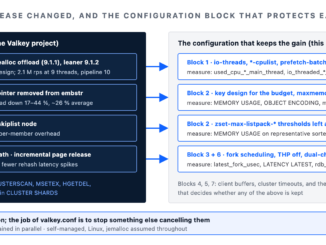
Valkey 9.1 Performance: What Changed Inside the Engine and How to Measure It

Valkey 9.1 performance work is the reason the 9.1 line exists. The 9.1.0 release (2026-05-19) reworked the I/O threading queues, doubled the embedded-string threshold, turned the processor clock on by default, embedded sorted-set elements in […]
Redis 8.8 cache tier cutting time to result for distributed PostgreSQL query performance in SaaS platforms - hourglass on calendar symbolizing query latency and TTL-based caching
Database Performance

How Redis 8.8 Improves Distributed PostgreSQL Query Performance in SaaS Platforms

Redis 8.8 improves distributed PostgreSQL query performance in SaaS platforms: kvobj memory savings, INCREX rate limiting, hot-key telemetry and a measured cache-aside design.
[...]
Redis 8.10
Database Performance

Redis 8.10 Performance and Reliability: What Actually Changed

Redis 8.10 performance and reliability: the short version Redis 8.10 performance and reliability: the three changes that alter how you size and operate a Redis fleet. The headline for Redis 8.10 performance is that this [...]

Posts pagination

1 2 »

Search MinervaDB Blog 🔎

Tell us how we can help!

Loading

★Read this WARNING★

* Everything changes over time – Our blogs/posts and comments changes over time, That’s how it should be! Whatever we comment from MinervaDB Inc. Teams (including Shiv Iyer) and other stakeholders or guest bloggers posted here are never permanent, These things worked for us. But, there is no guarantee they will work for you too, When using the recommendations from ChistaDATA or MinervaDB or MinervaSQL or any other online resources / Google,  You must test the advice before applying them to your production systems, and always invest for a robust Database DR solution, Thank you for understanding. 

Recent Posts ✏

  • Expensive SQL on Exadata 26.1: Read the Offload Numbers Before You Build the Index
  • SQL Server 2025 Expensive Queries: 7 Proven Ways to Find and Fix Them by Latency and Resource Cost
  • Db2 13 for z/OS Index Efficiency: 8 Proven Troubleshooting Techniques
  • AlloyDB Pricing and Internals: 2026 FinOps Best Practices Guide
  • Google AlloyDB Architecture, Internals and Performance: 2026 Best Practices Guide

☎ Contact Global Sales (24*7)

📞 (844) 588-7287 (USA)

📞 (415) 212-6625 (USA)


☎ TOLL FREE PHONE (24*7)

(844) 588-7287 

📌 Our Support Channels (24*7)

✔ Email
✔ IRC
✔ Phone
✔ Ticketing System

🚩 MinervaDB FAX

+1 (209) 314-2364

Corporate Address: California

MinervaDB Inc.
440 N BARRANCA AVE #9718 COVINA,
CA 91723
════════════════════════════════
Email: contact@minervadb.com

Corporate Address: Delaware

MinervaDB Inc.,
PO Box 2093 PHILADELPHIA PIKE #3339
CLAYMONT, DE 19703
════════════════════════════════

Email: contact@minervadb.com

📨 Contact MinervaDB (24*7)

 Email – contact@minervadb.com 

(We are online 24*7)

☛ Contact Shiv Iyer
▬▬▬▬▬▬▬▬▬▬▬▬▬
 Email – shiv@minervadb.com

HOW CAN WE HELP?

We are committed to building Optimal, Scalable, Highly Available, Reliable, Fault-Tolerant and Secured Database Infrastructure Operations for WebScale to our customers globally

📨 Contact MinervaDB Support (24*7)

✔ Support (24*7) – support@minervadb.com

✔ Google Hangouts – support@minervadb.com

(for emergency support and quick response)

💲Flexible Payment

✔ Wire

✔ PayPal

✔ Credit / Debit Cards

✔ Cheque

✔ Cash

★ Discounts ★

Discounts are applicable only for multi-year contracts / long-term engagements, We don’t hire low-quality and cheap rookie consultants to manage your mission-critical Database Systems Infrastructure Operations and so our consulting rates are competitive. Being a virtual corporation (no physical offices anywhere in the world), whatever you pay go directly to our consultant’s fee. It’s impossible for us to offer you low-cost consulting, support and remote DBA services with elite-class team, Thanks for understanding and doing business with MinervaDB.

PostgreSQL is a registered trademark of the PostgreSQL Community Association. ClickHouse is a registered trademark of ClickHouse, Inc. MongoDB is a registered trademark of MongoDB, Inc. Couchbase is a registered trademark of Couchbase, Inc. Redis is a registered trademark of Redis Ltd. Apache Cassandra is a registered trademark of the Apache Software Foundation. Milvus is a registered trademark of Zilliz. MinIO is a registered trademark of MinIO, Inc. Amazon Redshift and Amazon Aurora are registered trademarks of [Amazon.com](http://amazon.com/), Inc. Google Cloud is a registered trademark of Google LLC. Snowflake is a registered trademark of Snowflake Inc. Databricks is a registered trademark of Databricks, Inc. MySQL and InnoDB are registered trademarks of Oracle Corporation. MariaDB is a trademark of MariaDB Corporation Ab. All other trademarks are the property of their respective owners. Copyright © 2010–2026. All Rights Reserved by MinervaDB®.

Table of Contents

×
  • Redis 8.10 performance and reliability: the short version
  • Step zero: establish exactly what you are running
  • Change 1: Compact hashes and the memory line item
    • What changed
    • Measuring it
    • The bulk-load path: HIMPORT
    • Configuration: what to set, and when
    • Who is affected, and where it does not help
  • Change 2: The BACKUP command family — online backups without the shell scripts
    • What changed
    • The workflow
    • Restore
    • Why this matters operationally
  • Change 3: Replication and full-sync hardening
  • Redis 8.10 performance in context: the 8.4 → 8.10 curve
  • Redis 8.10 reliability fixes that are upgrade drivers on their own
  • Bounded replies: the quietest Redis 8.10 reliability win
  • What Redis 8.10 does not change
  • Redis 8.10 vs Valkey 9.1: how to read the fork
  • Our upgrade stance (dated: 15 August 2026)
    • Upgrade checklist
  • Frequently asked questions
  • Working with MinervaDB
  • Sources
→ Index