MariaDB Consultancy Services
MinervaDB delivers senior-led onsite and remote consulting for engineering teams that operate MariaDB at the very edge of scale, where every millisecond of latency, every point of availability, and every recovery objective is business-critical. Our practice spans the full lifecycle of a production database estate — architecture and schema design, deep performance engineering and query optimization, rigorous benchmarking and workload modeling, capacity planning and cost-efficient right-sizing, high-availability and replication topology design, database reliability engineering and observability, and hardened data recovery and security. Every engagement is delivered by battle-tested principal DBAs who have carried 1,200+ production clusters safely through relentless Black-Friday traffic peaks, unforgiving SLAs, and high-stakes 3 AM failovers — translating hard-won operational experience into resilient, observable, and predictably fast systems that your team can trust under the heaviest load.
Architecting MariaDB Operations for Web-Scale Performance and Reliability
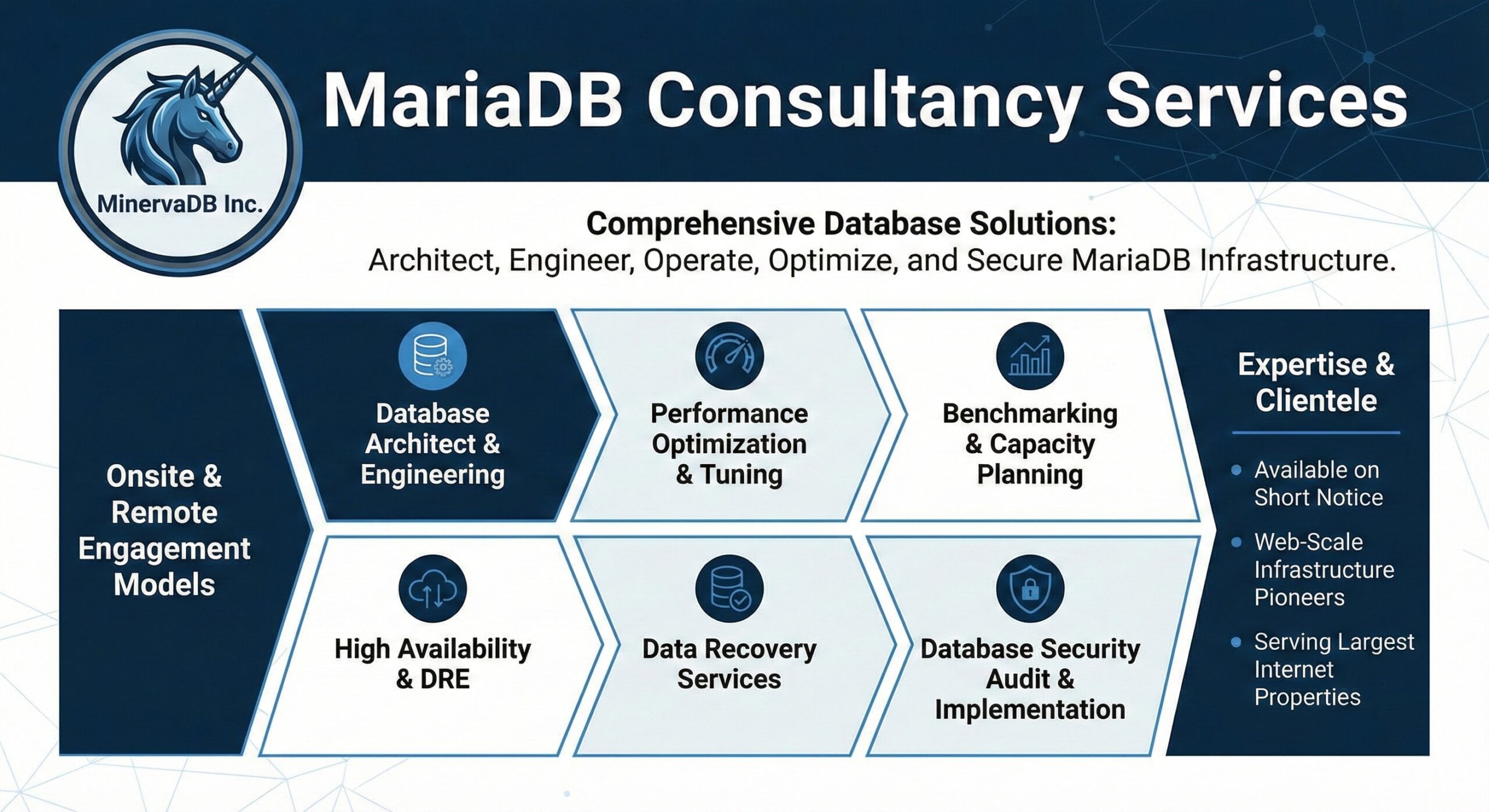
MinervaDB provides both onsite and remote consultancy services for MariaDB covering Database Architecture, Engineering and Operations, Performance Optimization and Tuning, Benchmarking, Capacity Planning and Sizing, High Availability and Database Reliability Engineering, Data Recovery Services, and Database Security. Our consultants are typically available on short notice and work for some of the largest internet properties and pioneers in building web-scale database infrastructure on MariaDB.
You can download the MinervaDB Consulting & Professional Services for MariaDB flyer here to learn more about our service delivery models and value proposition. Our dedicated MariaDB consulting team is ready to help across architecture, performance, availability, recovery and security.
MariaDB powers mission-critical applications from e-commerce checkouts to real-time analytics, yet many teams still treat it as “just another MySQL fork.” This guide distils battle-tested patterns we use when customers ask us to scale past 100K queries/second, hold 99.99% availability, and meet GDPR-grade security — all without rewriting their applications.
Each section below expands on the engineering discipline behind a resilient MariaDB platform: how to size hardware before you scale, how to write SQL that stays cheap as data grows, how to choose storage engines, how to design schemas that shard cleanly, how to run a 24×7 operations desk, and how to prove your database is fast, available and compliant.
1. Capacity Planning & Sizing: Right-Size Before You Scale
Capacity planning is where most scaling incidents are quietly won or lost. Under-provision and you throttle at the worst possible moment — a checkout stampede, a viral launch, a month-end batch. Over-provision and you burn budget on cores that never leave idle. The discipline is to size a MariaDB instance around its most saturated resource, because a database is only ever as fast as whichever of CPU, memory, IOPS or network hits the wall first.
We size across four coupled dimensions rather than a single “instance type”: CPU for concurrency and query execution, memory for the InnoDB buffer pool and per-connection buffers, storage IOPS and throughput for redo, flushing and cache misses, and network for replication and result-set delivery. The reference profiles below are our field-tested starting points on AWS Graviton and Intel families; the same ratios translate directly to GCP, Azure and bare-metal.
| Workload Profile | vCPU : RAM | IOPS / Throughput | Storage Class | Buffer Pool | AWS Reference | GCP / Azure Equivalent | Primary Bottleneck |
|---|---|---|---|---|---|---|---|
| OLTP — read-heavy | 1 : 4 | 1,000 IOPS / 250 MB/s | gp3 SSD | ~75% RAM | c7g.2xlarge (8 vCPU / 32 GB) | n2-highcpu-8 / D8s v5 | Buffer-pool hit ratio |
| OLTP — write-heavy | 1 : 2 | 2,000–10,000 IOPS / 500 MB/s | io2 / local NVMe | ~65% RAM | i4i.xlarge (4 vCPU / 32 GB) | c3-highmem-8 / E8ds v5 | Redo & flush throughput |
| OLTP — balanced | 1 : 3 | 1,500–3,000 IOPS / 350 MB/s | gp3 SSD | ~70% RAM | m7g.2xlarge (8 vCPU / 32 GB) | n2-standard-8 / D8s v5 | Mixed — watch p95 latency |
| Analytics — columnar | 1 : 8 | 500 IOPS / 1,000+ MB/s | st1 / gp3 (throughput) | N/A (ColumnStore) | r7g.xlarge (4 vCPU / 32 GB) | n2-highmem-8 / E8ds v5 | Scan throughput & RAM |
| HTAP / mixed | 1 : 6 | 3,000 IOPS / 750 MB/s | io2 | ~60% RAM | r7g.2xlarge (8 vCPU / 64 GB) | n2-highmem-8 / E16ds v5 | Contention & isolation |
| High-concurrency web | 1 : 3 | 2,000 IOPS / 400 MB/s | gp3 SSD + pooler | ~70% RAM | c7g.4xlarge (16 vCPU / 32 GB) | c3-standard-16 / F16s v2 | Connection & thread scheduling |
| Batch / ETL | 1 : 4 | 5,000 IOPS / 1,000 MB/s | io2 / local NVMe | ~65% RAM | m7g.4xlarge (16 vCPU / 64 GB) | n2-standard-16 / D16ds v5 | Sequential write throughput |
| Dev / staging | 1 : 2 | baseline gp3 | gp3 SSD | ~50% RAM | t4g.large (2 vCPU / 8 GB) | e2-standard-2 / B2s | Cost, not performance |
Ratios are expressed as vCPU : RAM (GiB). Treat the AWS / GCP / Azure columns as families rather than exact SKUs — the right node is the smallest one whose bottleneck column has comfortable headroom under peak load.
How We Forecast Demand
Sizing from a spreadsheet guess ages badly. We forecast concurrency analytically with Little’s Law, L = λW, where λ is the query arrival rate (queries/second) and W is average query service time (seconds); the product L is the number of in-flight requests you must provision connection slots, threads and CPU for. For example, 8,000 queries/second at a 4 ms average service time implies roughly 32 concurrent in-flight queries — a figure that drives both max_connections and core count.
On top of the steady-state number we layer explicit headroom for known demand patterns rather than a single blanket multiplier. Disk growth is modelled as a compound Poisson process; once indexes, undo history and fragmentation are included, the 95th-percentile yearly footprint is typically about 3.7× the raw inserted data volume.
| Planning Factor | Recommended Headroom | Applies To | Rationale |
|---|---|---|---|
| Baseline burst | +30% | CPU, IOPS | Absorb normal intraday peaks without queueing |
| Flash sale / launch | +100–300% | CPU, connections, IOPS | Short, predictable spikes far above the mean |
| Viral / unplanned spike | +50% standing reserve | CPU, replicas | Buys time for autoscaling and replica promotion |
| Annual data growth | ×3.7 raw inserts | Storage, buffer pool | Indexes, undo and fragmentation overhead |
| Failover absorption | N−1 capacity | Whole cluster | Surviving nodes must carry full load after a loss |
| Maintenance windows | +20% transient | IOPS, CPU | Online DDL, OPTIMIZE, backups compete for I/O |
Matching Storage Class to Workload
| Storage Option | Best For | IOPS Ceiling | Throughput | Notes |
|---|---|---|---|---|
| gp3 SSD | General OLTP, read-heavy | 16,000 | 1,000 MB/s | Provision IOPS and throughput independently of size |
| io2 Block Express | Write-heavy, low-latency OLTP | 256,000 | 4,000 MB/s | Sub-millisecond, 99.999% durability — premium tier |
| Local NVMe (i4i / im4gn) | Highest write throughput | Millions | >10 GB/s | Ephemeral — must pair with replication / backups |
| st1 (throughput HDD) | Sequential analytics scans | 500 | 500 MB/s | Cheap for ColumnStore / log-style access |
| gp2 (legacy) | Migration only | 16,000 | 250 MB/s | Prefer gp3 — cheaper and more flexible |
Sizing order of operations
Size the buffer pool for the hot working set first, then IOPS to survive cache misses, then CPU for concurrency, then network for replication fan-out. Getting this order wrong is the single most common cause of “we scaled the instance up and it’s still slow.”
Validate against telemetry, not assumptions
Every profile above is a starting point. Confirm the fit with 7–14 days of production metrics — buffer-pool hit ratio, I/O wait, p95 latency and replication lag — before locking in an instance family or a reserved-capacity commitment.
2. Optimal & Scalable SQL Engineering
Fast databases start with disciplined SQL and schema. We treat every query as a contract against an index, and we enforce that contract in CI so regressions never reach production.
Schema first, queries second
- Use
INT UNSIGNEDuntil you genuinely expect more than 4 billion rows, then migrate toBIGINT. utf8mb4is mandatory — legacyutf8silently truncates 4-byte characters such as emoji, causing hard-to-trace data loss.
Access-path contracts
Every SELECT must hit a covering index or prune to a partition. We enforce this with an EXPLAIN FORMAT=JSON gate in CI that fails the build whenever rows_examined exceeds 20× rows_returned — a reliable early warning for missing or wrong indexes.
Hot-spot-free sequences
On MariaDB 10.6+ we replace contended AUTO_INCREMENT with node-local, non-persistent SEQUENCE objects using CACHE 1000 to eliminate the auto-increment mutex. For multi-region deployments we combine sequences with an offset-and-step sharding key so every region generates non-colliding IDs.
3. Choosing Storage Engines for Performance, Scalability & HA
One of MariaDB’s strengths is its pluggable storage engine architecture. Choosing the right engine per table — rather than defaulting everything to InnoDB — can deliver order-of-magnitude gains in compression, write throughput or analytical scan speed.
| Engine | Best For | Avoid When | Key Characteristic |
|---|---|---|---|
| InnoDB | Default OLTP needing ACID and row locks | Streaming very large BLOBs | Crash-safe, MVCC, clustered index |
| MyRocks | Write-heavy workloads; 2–3× compression | Heavy range scans | LSM-tree, low write amplification |
| Aria | Internal temp tables, read-mostly caches | User data (not crash-safe) | Fast, lightweight, non-transactional |
| ColumnStore | Petabyte-scale analytics | Sub-second point lookups | Distributed columnar MPP |
| Spider | Transparent horizontal sharding | Cross-shard joins >5% of queries | Federated sharding layer |
Purge-lag early warning
Run SHOW ENGINE INNODB STATUS every 30 seconds. If the History list length exceeds 1,000,000, long-running transactions are stalling purge — expect imminent undo/disk bloat and rising query latency.
4. Designing Schema for Performance & Scalability
Functional partitioning
Split a monolithic schema into domain-aligned services, each with its own database, so teams can evolve and scale their data independently without cross-team migration coupling.
Horizontal sharding key rules
- Key cardinality should comfortably exceed the number of future shards (target ≥ 1,000).
- Distribution must be even — validate with a χ² test and require a p-value > 0.05.
- Avoid cross-shard unique constraints; they force expensive global coordination.
JSON instead of EAV
For sparse attributes, MariaDB’s dynamic columns (COLUMN_CREATE / COLUMN_GET) are roughly 4× faster than joining five separate attribute tables in a classic entity-attribute-value model, while keeping schemas flexible.
5. Remote DBA Services: The 24×7 Run-Book
Our managed operations desk runs on a codified run-book so that every engineer, on every shift, responds identically to the same signal. Predictable operations are the foundation of measurable reliability.
Golden-signals dashboard
We instrument five golden signals: queries per second (QPS), 95th-percentile latency, replication lag, disk utilisation, and Innodb_row_lock_waits. Everything else is a drill-down from these.
Chaos Friday
Every week we randomly terminate an Availability Zone in staging and (with consent) in controlled production windows. The bar we hold ourselves to: <60 second RTO and zero RPO. Failover you don’t rehearse is failover you don’t have.
Auto-triage policy
| Condition | Automated Response | Objective |
|---|---|---|
| Replication lag > 5 s | Page the on-call DBA | Human eyes before customers notice |
| Replication lag > 30 s | Auto-promote async replica (Orchestrator) | Protect read SLAs without waiting |
| Disk utilisation > 85% | Trigger purge review + capacity alert | Prevent write stalls from full volumes |
6. Performance & Scalability Deep Dive
6.1 Benchmarking toolkit
We baseline every engagement with sysbench so tuning is measured against a repeatable number, not a feeling:
sysbench oltp_read_write \
  --mysql-host=db1 --mysql-user=sbtest --mysql-password=*** \
  --tables=32 --table-size=10000000 --threads=128 \
  --time=300 --report-interval=1 \
  --mysql-storage-engine=innodb \
  --mysql-ignore-duplicates=on run
Reference target: >50,000 tps on a c6i.4xlarge. Falling materially short signals a configuration, schema or index problem worth investigating before scaling hardware.
6.2 Tuning workflow
- Capture a 60-second
SHOW PROCESSLISTand identify the top 20 queries by cost. - Run
EXPLAINand add composite indexes until examined rows fall below 10× the expected result set. - Re-test, then audit with
mariadb-dump --no-data | grep KEYto remove redundant indexes (each unused index adds >5% write overhead).
6.3 Scale-out without shards
Before committing to the operational complexity of sharding, we exhaust replica-based scaling: asynchronous plus semi-synchronous read replicas (rpl_semi_sync_master_wait_point=AFTER_SYNC) for read scale-out, and Galera for synchronous write scale-out — keeping wsrep_certification_rules=optimistic for roughly 15% higher throughput.
7. High Availability & Disaster Recovery
We match the HA topology to the business’s tolerance for data loss (RPO) and downtime (RTO), and to budget. The table below summarises the trade-offs we walk customers through.
| Solution | RPO | RTO | Relative Cost |
|---|---|---|---|
| Async replica + Orchestrator | < 60 s | < 3 min | $ |
| Galera 3-node cluster | 0 s | < 30 s | $$ |
| Galera + MaxScale + binlog router | 0 s | < 10 s | $$$ |
| Cross-region DR + Spider + delayed replica | < 5 min | < 15 min | $$$ |
Backup strategy
- Logical:
mariadb-dump --single-transaction --master-data=2nightly. - Physical:
mariabackup --backup --stream=xbstreamevery 6 hours. - Point-in-time: binary logs shipped to S3 with
binlog_expire_seconds=86400.
Untested backups are not backups
We schedule automated restore drills and verify checksums. A backup only counts once it has been restored successfully into an isolated environment.
8. Data Privacy & Security Consulting
We implement dynamic masking and irreversible pseudonymisation so that PII, PAN and PHI never leave production unprotected. Security is designed into the data path, not bolted on at the perimeter.
Tool chain
- MaxScale Masking Filter — regex-based obfuscation applied on-the-fly at the proxy layer.
- ColumnStore anonymisation — tokenisation via
SHA2(CONCAT(salt, pan), 256). - GDPR right-to-be-forgotten —
DELETE+OPTIMIZE TABLEwithpt-online-schema-changeto reclaim space with zero downtime.
Compliance mapping
| Regulation | Technical Control | Audit Artifact |
|---|---|---|
| GDPR | Pseudonymisation; 30-day deletion SLA | Data-processing register |
| PCI DSS v4.0 | Network segmentation; PAN truncation | ASV scan report, ROC |
| HIPAA | AES-256 at rest; TLS 1.3 in transit | Security risk analysis (SRA) |
| SOX | Immutable audit trail; dual control | GPG-signed DB change-log |
9. Quick-Wins Checklist
Most instances we inherit have several of these unset. They are low-risk, high-return changes we typically validate and apply in the first engagement.
| Setting / Action | Recommended Value | Benefit |
|---|---|---|
innodb_buffer_pool_size |
75% of RAM (cap ~512 GB) | Keeps the working set in memory |
innodb_flush_method |
O_DIRECT_NO_FSYNC (on NVMe) | Removes double buffering on flash |
log_slow_verbosity |
query_plan,innodb | Rich diagnostics for slow queries |
long_query_time |
0.1 | Catches sub-second offenders early |
Weekly mysqlcheck --optimize |
Off-peak schedule | Defragments and refreshes stats |
max_connections |
≤ 2,000 + pooler | Use MaxScale/ProxySQL instead of raw connections |
10. When to Call the Experts
- You expect a >10× traffic spike within 90 days and need to be certain the platform will hold.
- Replication lag is cyclic and unexplained, and dashboards aren’t telling you why.
- A compliance audit is 30 days out and PANs or PII are still in plaintext.
- You need a zero-downtime migration from AWS RDS to on-prem Galera (or the reverse).
Our Remote DBA and Database Reliability Engineering teams have carried 1,200+ MariaDB clusters through Black-Friday peaks, GDPR audits and 3 AM failovers — so you don’t have to.
Free 30-Minute Architecture Review
Contact us for a complimentary architecture review and walk away with an actionable performance roadmap tailored to your dataset and growth curve.
Book Your Architecture Review → Email contact@minervadb.com →
MinervaDB Benefits
| MariaDB Database Infrastructure Operations Security Audit | Rate ( plus GST / Goods and Services Tax where relevant ) |
|---|---|
| Detailed Database Infrastructure Operations Security Audit and Recommendations for MariaDB | US $25,000 / MariaDB Instance |
- Vendor neutral and independent, Enterprise-class consulting, 24*7 support and remote DBA services for MySQL, MariaDB, MyRocks, PostgreSQL and ClickHouse.
- Virtual corporation with an global team of seasoned professionals – We have consultants operating from multiple locations worldwide, All of us work from home and stay connected via email, Google Hangouts, Skype, private IRC, WhatsApp, Telegram and phone. Being an virtual corporation we can hire the best talent from anywhere in the world, This makes an truly 24*7 operational team.
- Competitive pricing – We are an virtual corporation so we don’t charge the customers for our infrastructure cost, What you pay us goes purely for our unmatched technology team.
- Big Data Analytics and Columnar Store expertise – MariaDB ColumnStore and ClickHouse.
- We operate 24*7 – Our team operates from multiple locations worldwide so we are available 24*7.
- Pay As You Go billing model – You pay us only for the hours worked, We don’t ask for advances ever !! We are committed to delivering cost efficient consulting, support and services for our customers globally.
- Transparent ticketing system – We share with you the detailed work report of what we have done for your database infrastructure, This also includes how you will get benefitted with change we have done. We love absolutes transparency and detailed documentation.
- Emergency support available for you even when you are not our customer, Emergency support channels – Email, Slack, Google Hangouts, Skype, Yahoo Messenger and Phone.
- Pay per incident option available – You need our support in just fixing a single incident ? No problem, We have that option available.
- Vacation DBA Service – We can support your database infrastructure operations when the resident DBA is on a holiday / vacation so you can guarantee an optimal work-life balance for your DBA.
- Cloud DBA Services – IaaS and DBaaS including: Oracle Cloud, Google CloudSQL, Amazon Aurora, AWS RDS®, EC2®, Microsoft Azure® and Rackspace® Cloud.
A low cost and instant gratification health check-up for your MariaDB infrastructure operations
- Highly responsive and proactive MariaDB performance health check-up, diagnostics and forensics.
- Detailed report on your MariaDB configuration, expensive SQL, index operations, performance, scalability and reliability.
- Recommendations for building an optimal, scalable, highly available and reliable MariaDB infrastructure operations.
- Per MySQL instance performance audit, detailed report and recommendations.
- Security Audit – Detailed Database Security Audit Report which includes the results of the audit and an actionable Compliance and Security Plan for fixing vulnerabilities and ensuring the ongoing security of your data.
** You are paying us only for the MariaDB instance we have worked for :
| MariaDB Performance Audit | Rate ( plus GST / Goods and Services Tax where relevant ) |
|---|---|
| MariaDB infrastructure operations detailed health check-up, diagnostics report and recommendations | US $30,000 / MariaDB instance |
How business gets benefitted from our MariaDB health check-up, diagnostics reports and recommendations ?
- You can hire us only for auditing the selected MariaDB instances.
- Proactive and result oriented approach for MariaDB maximum availability and reliability.
- Detailed MySQL infrastructure operations audit report, interpretation and recommendation for performance, scalability, availability and database infrastructure operations reliability.
- On-demand – You can schedule for an on-demand MySQL infrastructure operations health check-up once registered as our customer (customer registration will be free forever).
- Security Audit and Recommendations for your Database Infrastructure Operations.
- Flexible payment options – PayPal, Wire, Cheque and Cash.
- Vendor neutral and independent – MySQL, MariaDB, Percona Server, MyRocks, InnoDB / XtraDB, TokuDB and RocksDB.
Consulting Rates (We do both on-site and remote MariaDB consulting)
Sometimes you need Sr. level MariaDB consultants on-site for both strategic and technical consulting, Our consultants have several years of experience in architecting and building web-scale database infrastructure operations addressing performance, scalability and high availability . We have travelled to 46 cities in the world for Database Architect and DBA consulting.
| On-Site MariDB Consulting | Rate ( plus GST / Goods and Services Tax where relevant ) |
|---|---|
| Per Diem | US $500 / hour |
We can do everything remote (except few strategic database infrastructure operations discussions which demand on-site presence ) when it comes to MariaDB technical consulting, This include performance optimization , scaling database infrastructure operations (both vertically and horizontally ) , high availability, disaster recovery and data recovery services. We are usually available on an short notice.
| Remote MariaDB Consulting | Rate ( plus GST / Goods and Services Tax where relevant ) |
|---|---|
| Per Diem | US $350 / hour |
★ We deliver Consulting and Professional Services for MySQL, MariaDB, Percona Server, MyRocks and PostgreSQL .
Data Recovery Services
We can provide Data Recovery Services for MySQL, MariaDB and Percona Server in the case following scenarios :
- Accidently dropped databases or tables
- Corrupted data files
- Corrupted XtraBackup
- Corrupted replication
- Corrupted file system
- ** If you have data in media, We can recover it for you !
| Data Recovery Services | Rate ( plus GST / Goods and Services Tax where relevant ) |
|---|---|
| Per Diem | US $500/hour |
** We always try our best to recover data for you (our recovery rate is high) but sometimes we may not be able to recover 100% of your data.
Flexible consulting plans
If you are a startup or need only few hours of consulting every month then our flexible consulting plan will be the most optimal solution for you, You will have access to our seasoned team of consultants on-demand without signing-up for any longterm consulting contracts:
| Avg. Hours / Month | Quarterly ( plus GST / Goods and Services Tax where relevant ) | Six-Monthly ( plus GST / Goods and Services Tax where relevant ) | Annually ( plus GST / Goods and Services Tax where relevant ) |
|---|---|---|---|
| 4 | US $4,500.00 | US $8,500.00 | US $15,500.00 |
| 8 | US $7,500.00 | US $12,500.00 | US $25,500.00 |
| 12 | US $7,500.00 | US $15,500.00 | US $27,500.00 |
| 16 | US $8,500.00 | US $16,500.00 | US $30,500.00 |
| 20 | US $10,500.00 | US $18,800.00 | US $35,500.00 |
| 24 | US $15,000.00 | US $25,000.00 | US $45,500.00 |
| 28 | US $18,500.00 | US $35,500.00 | US $52,500.00 |
| 32 | US $21,500.00 | US $40,000.00 | US $55,500.00 |
| 36 | US $28,000.00 | US $52,000.00 | US $75,000.00 |
| 40 | US $35,500.00 | US $65,500.00 | US $82,000.00 |

MinervaDB contacts – Sales & General Inquiries
| Business Function | Contact |
|---|---|
| ☎ CONTACT GLOBAL SALES (24*7) | 📞 (844) 588-7287 (USA) 📞 (415) 212-6625 (USA) 📞 (778) 770-5251 (Canada) |
| ☎ TOLL FREE PHONE (24*7) | 📞 (844) 588-7287 |
| 🚩 MINERVADB FAX | +1 (209) 314-2364 |
| 📨 MinervaDB Email - General / Sales / Consulting | contact@minervadb.com |
| 📨 MinervaDB Email - Support | support@minervadb.com |
| 📨 MinervaDB Email -Remote DBA | remotedba@minervadb.com |
| 📨 Shiv Iyer Email - Founder and Principal | shiv@minervadb.com |
| 🏠 CORPORATE ADDRESS: CALIFORNIA | MinervaDB Inc. 440 N BARRANCA AVE #9718 COVINA, CA 91723 |
| 🏠 CORPORATE ADDRESS: DELAWARE | MinervaDB Inc., PO Box 2093 PHILADELPHIA PIKE #3339 CLAYMONT, DE 19703 |
To know how we can help you in architecting and building an enterprise-class web-scale database infrastructure operations, please book an appointment here or send an email to contact@minervadb.com
Further Reading
- Data Engineering
- Enterprise-Class 24×7 Vertica Support
- The Ultimate Guide to Database Corruption: Prevention, Detection, and Recovery
- GreenPlum Consultative Support (24/7) from MinervaDB Inc: Enterprise Database Excellence
- Mastering MySQL Schema Changes with gh-ost: A Complete Implementation Guide
- MySQL Consulting
- MariaDB Support
- MySQL Support
